Computer Architecture System Interface Units
This document discusses the System Interface Unit (SIU) in the context of PowerPC architecture, particularly the PowerPC 601, which serves as an intermediary between the cache and the system bus. It explores key functions such as matching cache line lengths to main memory, handling read and write transactions, and ensuring cache coherence. The architecture enables effective bus utilization through separate address and data buses, allowing for overlapping transactions and improved performance. Insights into transaction management, including protocol and latency handling, are also presented to illustrate advanced processing capabilities.

Computer Architecture System Interface Units
E N D
Presentation Transcript
Computer Architecture System Interface Units Iolanthe II approaches Coromandel Harbour
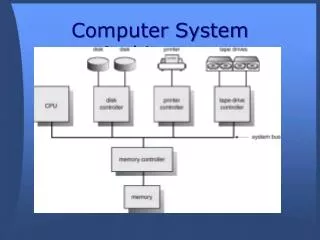
System Interface Unit (also BusIU) • Positioned between • cache and • system bus (external to die)
System Interface Unit (also BusIU) • Cache ó main memory bus • Responsible for • Matching cache line length to memory bus • eg PowerPC 601 • 32 byte cache line • 64 bit (8 byte) bus • Memory transactions are “bursts” of 4 double words • Giving priority to reads • Read requests stall CPU pipeline • Writes are assumed “complete” • when they exit the pipeline • Detecting reads on data in the write buffers • Cache coherence - later!
System Interface Unit • Read queue • 2-4 entries • Read will fetch a cache line • (PowerPC 8 words) • Need to fetch requested word first • May be word 0-7 in the cache line • Bus transactions may be “out of order” • Requested word first • Bus clock << processor clock • 30-60 MHz vs 200 - 600 MHz • 2 words / bus cycle • or 2 words / 3 - 20 CPU cycles! • Many CPU cycles if requested word is last read! 2003 data Add a factor of 3 or so!
System Interface Unit • Write buffer • 2-3 entries • Lower priority than read buffer • Additional (R10000) • Incoming buffer • External Agent (EA) supplying data writes to it • Processor doesn’t control transfer • EA signals completion anddata forwarded to cache • Uncached buffer • Pages may be marked “not cached” • Faster I/O transactions
System Interface Unit • Overlap greater bus utilisation • Separate Address and Data buses • Multiplexing two types of information on the same bus • Saves pins • Costs time - unable to assert both at once • Expensive for writes! • Required since …. whenever • Separate Address and Data bus tenure • Address and data phases split • Issue address1, wait for data1 • Issue address2 while waiting for data1
Boundary of the Si die PowerPC organisation PowerPC 601 ~1993 New - Look in the “Example Processors” section of the Web notes
Boundary of the Si die PowerPC organisation PowerPC 601 ~1993 • 3-way SuperScalar • Integer • Branch • Floating Point New - Look in the “Example Processors” section of the Web notes
Boundary of the Si die PowerPC organisation PowerPC 601 ~1993 • MMU • Unified TLB • (Data and I-misses) • Instruction TLB New - Look in the “Example Processors” section of the Web notes
Boundary of the Si die PowerPC organisation PowerPC 601 ~1993 • Cache • Unified • (Data and Inst) New - Look in the “Example Processors” section of the Web notes
Boundary of the Si die PowerPC organisation PowerPC 601 ~1993 • SIU • Read Q (2 entries) • Write Q (3 entries) New - Look in the “Example Processors” section of the Web notes
Bus Transactions • Primary task of SIU • Implement bus protocol • Sequence of signals and responses • Requesting access • Several devices can be bus masters • Granting access • Indicating type of transaction • Read, write, read-modify-write, cache invalidate, … • Transaction tag • Allows multiple transactions ‘in flight’ • Slow devices don’t block system • Address • Data
Bus Protocols • Depend on type of bus • Serial • Single (or small number) of data wires • Parallel • Smallest number of wires • Multiplexed address and data • Separate address and data • Most complex • Requiring separate grants to address and data buses • Highest throughput • Greatest tolerance for slow devices • See following diagram
System Interface Unit • Separate Address and Data bus tenure • Address and data phases split • Issue address1, wait for data1 • Issue address2 while waiting for data1
System Interface Unit • Separate Address and Data bus tenure • Address and data phases split • Issue address1, wait for data1 • Issue address2 while waiting for data1
Separate Address and Data buses • Overlap greater bus utilisation • Separate Address and Data buses • Separate Address and Data bus tenure • Address and data phases split • Issue address1, wait for data1 • Issue address2 while waiting • Increases utilisation of both buses • Device latency can be long • SIU doesn’t idle while device responds to access request
System Interface Unit • Next generation (eg PowerPC 620) • Multiple transactions active at any time • Each transaction identified by a transaction ID(3 bits on bus) • Allows multiple processors to interleave transactions on the bus • Further tolerance for long, variable latencies • Memory and devices may have different latencies • Multiple levels of memory • Devices: discs, networks, graphics, etc • Very long latency operation doesn’t block a (just) long latency one
Parallelism • Modern systems derive performance from ability to perform many tasks in parallel • Datapath • Pipelined – one instruction / stage • Instruction Issue Unit • Instruction Q • Superscalar • 3+ functional units execute multiple instructions • SIU • I/O transaction Qs • System bus • Several transactions active at any time • Peripherals • Several servicing requests at the same time
![Computer Architecture &amp; Operating System [O.S.]](https://cdn0.slideserve.com/35278/computer-architecture-operating-system-o-s-dt.jpg)