SlideServe
Menu
Préférences
© SlideServe · v2026

Counting through History: Learning Arithmetic from the Great Depression to World War II

sanne avatar
16 diapositives · 273 Views · Sep 04, 2014

Explore the significance of counting in American life through a captivating journey from the Great Depression to World War II. Witness Boyd Jones mastering arithmetic at Alexander Community School in Greene County, Georgia, as depicted in the Library of Congress' collection. Join Dr. J. Wilbur Chapman in understanding the importance of counting in everyday activities. Delve into various historical photographs and documents that highlight the evolution of arithmetic education and counting practices. Discover how numbers shape our world and why learning to count is a fundamental skill that transcends time.
Counting through History: Learning Arithmetic from the Great Depression to World War II - slide 1
01 / 16Counting through History: Learning Arithmetic from the Great Depression to World War II
1 / 17

Télécharger la présentation

Counting through History: Learning Arithmetic from the Great Depression to World War II
Une image / un lien ci-dessous est fourni (tel quel) pour télécharger la présentation

Politique de téléchargement : le contenu du site vous est fourni TEL QUEL pour votre information et votre usage personnel ; il ne peut être vendu, concédé sous licence ni partagé sur d’autres sites sans l’accord de son auteur.Le contenu vous est fourni TEL QUEL, pour votre information et votre usage personnel uniquement. Téléchargez la présentation en cliquant sur ce lien. Lors du téléchargement, si vous ne parvenez pas à télécharger une présentation, l’éditeur a peut-être supprimé le fichier de son serveur.Pendant le téléchargement, si vous ne parvenez pas à obtenir une présentation, le fichier a peut-être été supprimé par l’éditeur.

F I N

Plus de contenu associé

Transcription de la présentation
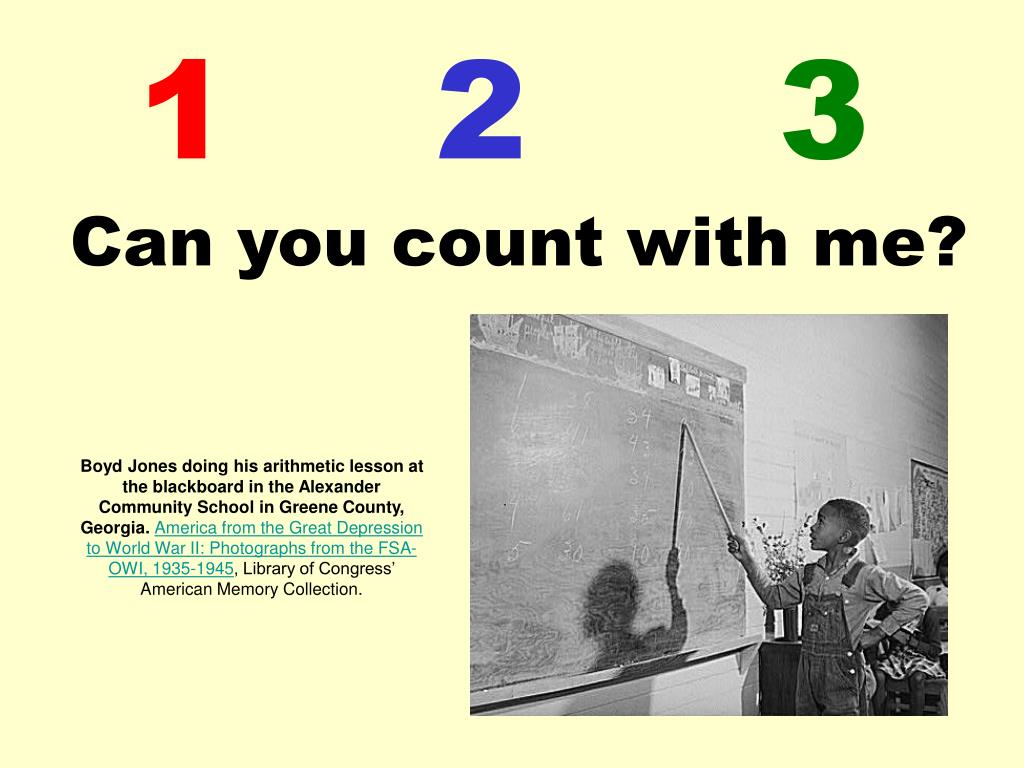
  1. 1 2 3 Can you count with me? Boyd Jones doing his arithmetic lesson at the blackboard in the Alexander Community School in Greene County, Georgia. America from the Great Depression to World War II: Photographs from the FSA-OWI, 1935-1945, Library of Congress’ American Memory Collection.

  2. Why do we learn to count? [Dr. J. Wilbur Chapman, holding up his hands as if counting on his fingers]. Part of Photographs from the Chicago Daily News, 1902-1933 in the Library of Congress’ American Memory Collection.

  3. 1

  4. 2

  5. 3

  6. 4

  7. 5

  8. 6

  9. 7

  10. 8

  11. 9

  12. 10

  13. 20

  14. ?

  15. Bibliographic Information • Mary Elizabeth "Mitzi" Rhoads on a speed Flivver / photo by Harry M. Rhoads. American Memory’s History of the American West, 1860-1920: Photographs from the Collection of the Denver Public Library collection.http://memory.loc.gov/cgi-bin/query/r?ammem/hawp:@field(NUMBER+@band(codhawp+00185374)) • 2. Buses American Memory’s The South Texas Border: The Robert Runyon Photograph Collectionhttp://memory.loc.gov/cgi-bin/query/r?ammem/runyon:@field(DOCID+@lit(txuruny.02807)) • 3. AcanoetripthroughtheEverglades, ca. 1910. American Memory’s Reclaiming the Everglades: South Florida's Natural History, 1884-1934http://memory.loc.gov/cgi-bin/query/r?ammem/fmuever:@field(NUMBER+@band(fmuever+vm00010013)) • 4. DonkeysAmerican Memory’s History of the American West, 1860-1920: Photographs from the Collection of the Denver Public Library http://memory.loc.gov/cgi-bin/query/r?ammem/hawp:@field(NUMBER+@band(codhawp+00115609)) • 5. Little boys / photograph by Ansel Adams. American Memory’s Ansel Adams's Photographs of Japanese-American Internment at Manzanar http://memory.loc.gov/cgi-bin/query/r?ammem/manz:@field(NUMBER+@band(ppprs+00164))

  16. 6. [Six members of the Goose Island Fire Department standing on and in front of a horse drawn fire department wagon]. American Memory’s Photographs from the Chicago Daily News, 1902-1933 http://memory.loc.gov/cgi-bin/query/r?ammem/cdn:@field(NUMBER+@band(ichicdn+n004639)) 7. [Seven young women wearing bathing suits, dancing on the shore of a beach during a Y. M. C. A. outing]. American Memory’s Photographs from the Chicago Daily News, 1902-1933http://memory.loc.gov/cgi-bin/query/r?ammem/cdn:@field(NUMBER+@band(ichicdn+n083833)) 8. The landing of Columbus at San Salvador, October 12, 1492, Prints and Photographs Online Catalog, http://memory.loc.gov/cgi-bin/query/r?pp/ils:@filreq(@field(NUMBER+@band(cph+3c05062))+@field(COLLID+pga)) 9. Potomac Boat Club.American Women: A Gateway to Library of Congress Resources for the Study of Women's History and Culture in the United Stateshttp://memory.loc.gov/cgi-bin/query/r?ammem/awhbib:@field(NUMBER+@od1(cph+3b38705)) 10. Pumpkins near Berlin, Connecticut. American Memory’s America from the Great Depression to World War II: Photographs from the FSA-OWI, 1935-1945 , http://memory.loc.gov/cgi-bin/query/r?ammem/fsaall:@field(NUMBER+@band(fsa+8a27273)) A. Butterfly applique quilt made by Mrs. Bill Stagg, homesteader from Texas and Oklahoma. Pie Town, New Mexico. American Memory’s America from the Great Depression to World War II: Photographs from the FSA-OWI, 1935-1945 http://memory.loc.gov/cgi-bin/query/r?ammem/fsaall:@field(NUMBER+@band(fsa+8b25288)) B. [Twenty-two policemen forming a human pyramid on the backs of nine running horses]. American Memory’s Photographs from the Chicago Daily News, 1902-1933 http://memory.loc.gov/cgi-bin/query/r?ammem/cdn:@field(NUMBER+@band(ichicdn+n077580))