Exploring Hodoscopes in the COMPASS Experiment for Nucleon Spin Structure Analysis
The COMPASS (COmmon Muon and Proton Apparatus for Structure and Spectroscopy) experiment at CERN aims to unravel the spin structure of nucleons. Since its inception in 2001, it has utilized advanced components, including large and small angle spectrometers, polarized targets, and hodoscopes. This presentation details the hodoscope design, comprising scintillators, light guides, and magnetic shielding, which enable precise timing and tracking of particles. Key tasks involve configuring photomultiplier tubes and analyzing coincidence events to manage data storage efficiently.

Exploring Hodoscopes in the COMPASS Experiment for Nucleon Spin Structure Analysis
E N D
Presentation Transcript
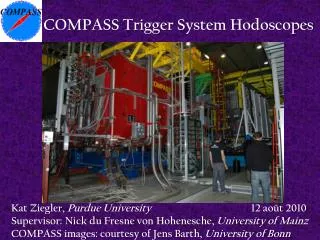
COMPASS Trigger System Hodoscopes Kat Ziegler, Purdue University Supervisor: Nick du Fresne von Hohenesche, University of Mainz COMPASS images: courtesy of Jens Barth, University of Bonn 12 août 2010
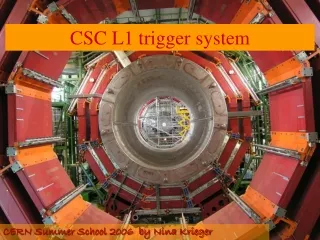
COmmon Muon and Proton Apparatus for Structure and Spectroscopy
COMPASS is located in Prévessin. It started taking technical run data in 2001. We hope to discover the spin structure of nucleons.
Components of COMPASS * Large angle & small angle spectrometers * Muon or hadron beam * Polarized fixed target * Tracking detectors * Ring imaging Cherenkov * Electron & hadron calorimeters * Hodoscopes
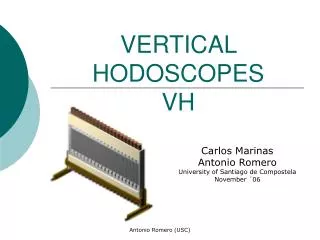
Hodoscopes Components * Scintillators * Light guides * Magnetic shielding * Photomultiplier tubes * High voltage dividers
Hodoscope Magnetic Shielding Components * Soft iron core * A little electrical tape * Kapton insulation layer * Mu-metal * Another Kapton insulation layer * Photomultiplier tube
Hodoscope Magnetic Shielding Tasks * Cut squares of Kapton * Wrapped mu-metal inside and out * Slid “scrolls” inside soft iron cores
Hodoscope FAQ Questions * What? Hodoscopes create a trigger signal. . . * When? Within a 500 ns window of detecting a relevant physics event. . . * How? By looking for coincidences (particles, whose trajectories can be retraced to the target via comparing the positions where they hit H1 and H2). . . * Why? To reduce the amount of data that needs to be stored.
Polarized Target * Ammonia or lithium deuteride * 60 mK Transverse PolarizationLongitudinal Polarization * 3 cylindrical cells (D=3 cm ) * 2 cylindrical cells (D=3 cm ) * or * or * 30 cm/60 cm/30 cm * 60 cm/60 cm * 10 cm spacing * 10 cm spacing There are 3 cells so the average acceptance is the same for and .
Summary of My Project * Became acquainted with C++, ROOT, and PHAST * Tested photomultiplier tubes and high voltage dividers * Connected photomultiplier tube signal cables * Tuned high voltage levels and signal thresholds * Assembled and installed magnetic shielding * Made cuts to plot only primary vertices located in the target cells * Extrapolated particle trajectories to hodoscope planes * Compared new 2010 data to 2007 data
Adventures * Montreux * Zürich * Venezia * Interlaken