Age Structure
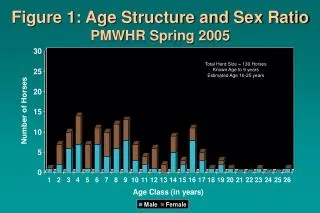
This resource covers essential concepts of age structure in fish populations, focusing on the use of age-length keys for accurate age determination. It explains how to calculate age structure using these keys, highlights common pitfalls in data interpretation, and identifies the practical applications of age structure data. Additionally, it delves into subsampling methods, including calculations for mean length-at-age and variance, providing a comprehensive understanding vital for fisheries research and management.

Age Structure
E N D
Presentation Transcript
Learning Objectives • Understand the uses of an age-length key • Calculate age structure using an age-length key • Identify uses of age structure data and common pitfalls
Subsample only Which one do you think is most accurate? From ALK
Age-Length Key • Mean length-at-age Li = ΣNijlij (Ni)-1 Si2 = [ΣNij (lij-Li)2] (Ni–1)-1 where, Li= mean length of the ith age group, Si2 = variance in mean length of the ith age group, Nij = Nj(nij/nj), Nj = total number of fish in the jth length group, nij = number of fish of the ith age group subsampled from the jth length group, nj = number of fish subsampled in the jth length group, lij is the mean length of fish of the ith age group subsampled from the jth length group, and Ni = ΣNij over all j length groups.
Age-Length Key If we only use the subsample, mean length is 77 mm Ni = ΣNij This is simply a weighted mean: Li = (ΣNij × lij) / Ni = 10,447 / 141 = 74 mm
Age-Length Key Si2 = [ΣNij (lij– Li)2] lij) / (Ni – 1) = 41,559 / 140 = 297