
Ecosystems and Their Importance: A Comprehensive Guide
E N D
Presentation Transcript
Ecosystems What is an ecosystem? Energy Flow in Ecosystems Cycling of matter
Why it matters….. • Humans are apart of a community of organisms • Humans are dependent on healthy ecosystems • Humans can disrupt ecosystems harming the organisms and themselves
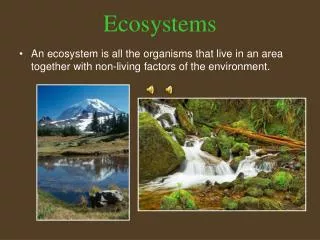
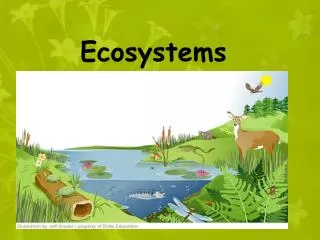
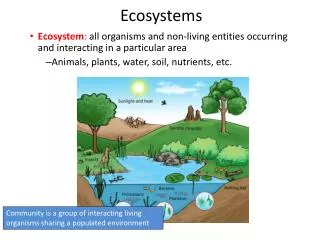
What is an ecosystem? • An ecosystem includes a community of organisms and their physical environment. • Web of relationships • Predator/prey • Symbiotic • Competition • Biotic and Abiotic factors
Habitat • Food, shelter, water, space • Biodiversity • Variety of organisms in a given area • Abiotic factors • When biodiversity decreases in an ecosystem, health of the ecosystem decreases.
Energy Flow in Ecosystems • Trophic levels • Each step in the transfer of energy in an ecosystem • Primary source, Sun • Producer • Consumer • Decomposer
Food Chain VS Food Web • Food Chain • Producer to herbivore to carnivore • Omnivore • Food Web • Interconnected food chains • Complicated • Loss of energy/10% Rule
Energy Pyramid • Demonstrates the amount of energy transferred to each level • 10% Rule
Succession • Replacement of one kind of community by another at a single place over a period of time • Change in an ecosystem • Volcano, fire, mudslides • Pioneer species • Equilibrium • Ecosystems respond to change so that equilibrium is restored
Major Biological Communities • Climate • Helps determine the types of organisms found in a particular place • Average weather conditions in an area over a long period of time (temp and precipitation) • Biome • Large region characterized by specific climate, plants, and animals
Terrestrial Biomes • Tropical Biomes • Temperate Biomes • High – Latitude Biomes
Aquatic Ecosystems • Freshwater • Wetlands • Estuaries • Marine ecosystems
Cycling of Matter • Organisms are made up of • Carbon, Oxygen, Hydrogen, Nitrogen, and Phosphorus • Matter needs to cycle through ecosystem • Water Cycle • Carbon and Oxygen Cycles • Nitrogen Cycle • Phosphorus Cycle
Water Cycle Continuous movement of water between the atmosphere, the land, and the oceans • Condensation • Precipitation • Percolates • Evaporation • Transpiration
Carbon Cycle • Continuous movement of carbon from nonliving environment into living things and back • Photosynthesis; carbon dioxide, organic molecules, water, oxygen • Animals; oxygen, breakdown organic molecules, carbon dioxide • Respiration is the exchange of O2 and CO2 • Combustion, burning of a substance
Nitrogen Cycle • Process in which nitrogen cycles among the air, soil, water, and organisms in an ecosystem • Organisms use nitrogen to make proteins • Atmosphere is about 78% Nitrogen gas • Nitrogen fixation is the process of combining nitrogen with hydrogen to form ammonia • bacteria, lightning, combustion
Phosphorus Cycle • Movement of phosphorus in different chemical forms from the surroundings to the organisms then back to the surroundings • Found in soil, rocks which break down and plants absorb through roots • Animals eat plants, when animals die phosphorus is released back into the soil