Convex Hulls and Polygons in Computer Science
250 likes | 284 Vues
Explore the concepts of convex hulls and polygons in computer science, including testing convexity, computing algorithms, and applying them in shape analysis and orientation determination.


Convex Hulls and Polygons in Computer Science
E N D
Presentation Transcript
Polygons and the convex hull Prof. Noah Snavely CS1114 http://www.cs.cornell.edu/courses/cs1114
Administrivia • Assignment 3 due this Friday by 5pm • Please sign up for slots on CMS
Finding the lightstick center • Threshold the image • Find blobs (connected components) • Find the largest blob B • Compute the median vector of B
Finding the lightstick center • But we also want to control the robot based on the orientation of the lightstick
Finding the lightstick center • So far we’ve only built functions that take a set of points and return another point • With one exception… • How can we express the shape of the lightstick?
Finding the lightstick center • We’ll try to come up with a simple polygon to describe the lightstick • Simplest polygon:the bounding box
Bounding box • Not as informative as we might like • Let’s come up with a polygon that fits better…
Detour: convex polygons • A polygon P is convex if, for any two points A, B inside P, all points on a line connecting A and B are also inside P B A
Convex polygons • Which polygons are convex? 2 3 1 4
Testing convexity • How can we test if a polygon P is convex? • Consider the smallest convex polygon containing P • Called the CONVEX HULL • What is the convex hull if P is convex?
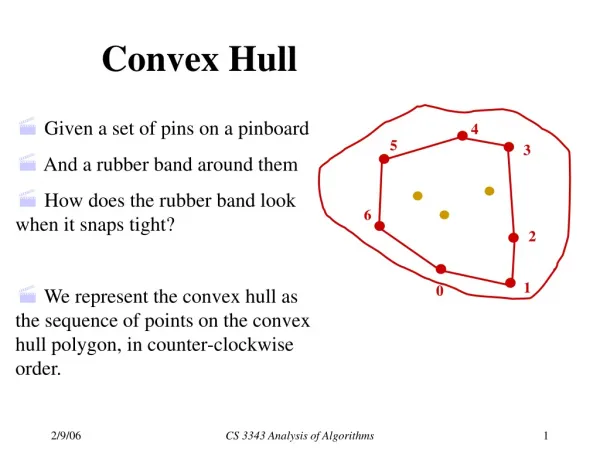
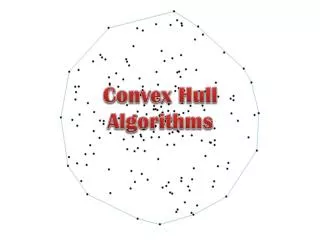
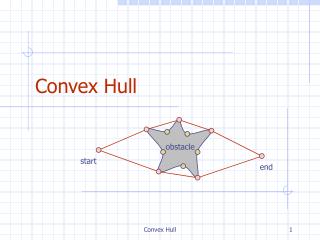
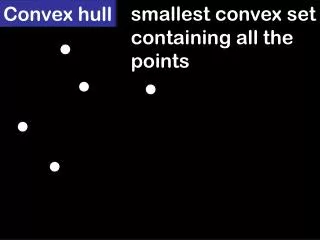
Convex hull • Can also define for sets of 2D points: the smallest convex shape containing a set of 2D points from http://en.wikipedia.org/wiki/Convex_hull
Convex hull of point sets • We can use this to find a simple description of the lightstick’s shape • How can we compute the convex hull?
Computing convex hulls • Idea: two points are an edge in the convex hull if ___________________
Computing convex hull • Which two horizontal lines touch points on the convex hull? • Which two vertical lines? • It is easy to identify at least four points that are part of the convex hull
Gift-wrapping algorithm • Start at lowest point • Rotate the line until we hit another point • All other points will lie on one side of this line • Look for the point that gives you the largest angle with the current line • Repeat • You’re done when you get back to the starting point Figure credit: Craig Gotsman
The details... } • Start at lowest point • Rotate the line until we hit another point • All other points will lie on one side of this line • Look for the point that gives you the largest angle with the current line • Repeat • You’re done when you get back to the starting point • How do we implement this part?
Vectors • To do this, let’s talk about 2D vectors • A vector v = (x, y) is an “arrow” with a direction and length • Similar to a 2D point y-axis (x, y) v x-axis (0,0)
Vectors length of v : ||v|| ||v|| = direction of v: (x, y) v (0,0)
Vectors v + u = (vx + ux, vy + uy) v u (0,0)
Vectors v v - u = (vx-ux, vy-uy) u (0,0)
Vectors • Can also “multiply” two vectors: • Dot product: • Useful fact:
Back to the convex hull w Which point is next? Answer: the point w that maximizes the angle between u – v and w – v v u - v u What is the running time of this algorithm?
Lightstick orientation • We have a convex shape • Now what? • Want to find which way it’s pointed • For now, we’ll find the two points that are furthest away from each other, and call that the “major axis”
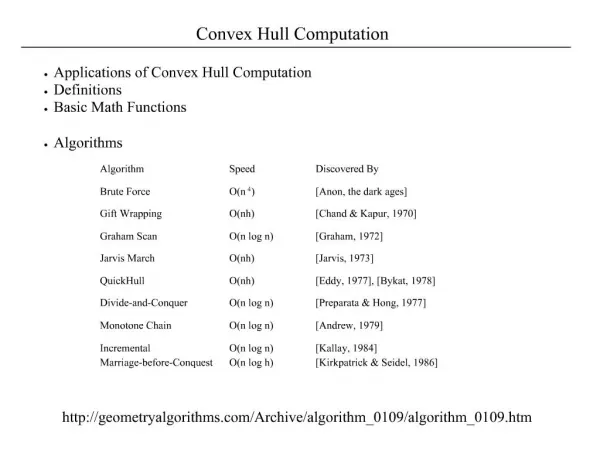
Computing the convex hull • Gift wrapping algorithm (“Jarvis march”) • Quickhull • (divide and conquer)