Download
1 / 11
110 likes | 231 Vues
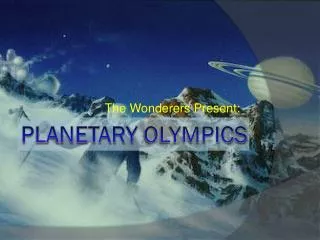
Dive into the fascinating world of the Planetary Olympics Exhibition, where visitors experience the gravitational strengths of different planets and the unique environmental conditions that shape sports. From lifting sports equipment simulating Mars' reduced gravity to competing in windsurfing on the gas giants like Jupiter and Saturn, each interactive exhibit demonstrates the universal laws of gravitation and their impact on athletic performance. Engage with displays and simulations that explore how varying gravity affects sports such as badminton on Venus and gliding on Neptune, making physics come alive through cosmic fun!

E N D
Planetary Olympics Exhibition The Collective Universal Gravitation The Planets Extra Features
General Workings of the Exhibition • The Gravitational Field • Simulates various gravitational strengths of each planet • The Planets and Respective Sports • Simulate various sports as if they were played under environmental factors found on corresponding planet • Extra Features • Other exhibits demonstrating interesting facts or related activities to supplement exhibition theme
The Gravitational Field—Field of Gravitations • Gravitational field strength vary between planets (universal law of gravitation) • Environmental Factor: Gravitational force experienced by objects determine their weights • Effect: (equipment-wise) less weight = less energy expended, modified projectile motion
The Gravitational Field– Exhibit Design • Demonstration: • Visitors try lifting sports balls of different masses that represent the same ball subjected to different gravitation • Compare throwing an object with low air resistance with one of high air resistance to simulate varied accelerations • Diagram goes here
The Venusbird—Venus • Terrestrial and has similar size and composition as Earth • Notable Environmental Conditions: • Hot surface temperature, i.e. exceeds 400°C • High density atmosphere (due to CO2) • Slightly lower gravitational field intensity (~90% Earth) • Higher air viscosity
The Venusbird—Badminton • Racket sport with shuttlecock as projectile • Little wind toleration makes Venus surface ideal • Shaped to produce great drag & skewed parabolic path Highly influenced by atmospheric conditions • Higher air density slower shuttlecock (buoyancy and drag) • Higher air viscosity slower shuttlecock • Lower gravitational pull slower shuttlecock drop • Overall: Aide players due to less demand on reaction time • Concepts: projectile motion & aerodynamics
The Venusbird – Exhibit Design • Display board: • Planetary conditions and effect on shuttlecock (& more) • Demonstration: • Transparent displays in which the visitor launches shuttlecocks and observe trajectory on Earth vs. Venus • Fluids of varied viscosity through which the visitor tries to drag objects to experience shuttlecock drag • Diagram is here
Galing Gas Giants • All Gas Giants share characteristic high winds and lack of solid surface, hence designated sports take advantage of these features • Jupiter & Saturn Windsurfing • Uranus Hang-Gliding • Neptune Gliding
The Glider of Neptune – Neptune • Gas giant with thick atmosphere, liquid surface, and high winds/storms • Notable Environmental Conditions: • Highest wind speeds in solar system (i.e. Up to 2000 km/h) • Great difference in temperature between core and outer cloud tops generate complex weather
The Glider of Neptune -- Gliding • Air sport involving glider (i.e. unpowered aircraft); competes for distance and speed • Higher net air speed more lift • Greater temperature gradient = more thermals more lift • Unstable weather turbulent ride • Overall: greater lift gains higher altitude, stays longer in air, covers greater distance • Concepts: aerodynamic force – lift
The Glider of Neptune – Exhibit Design • Display Board: • Planetary conditions and effect on glider • Demonstration: • Live-sized sailplane model, in which visitors sit, simulate glider movement and Neptune sight on screens • Mini gliders behaviour when subjected to various wind conditions (from fans) manipulated by visitors • Diagram goes here