SlideServe
Menu
Préférences
© SlideServe · v2026

Fascinating Pond Microorganisms: A Guide to Unique Protists

scottgeorge avatar
12 diapositives · 423 Views · Dec 19, 2019

Explore the diverse world of pond microorganisms, from the striking pink Blepharisma to the voracious Didinium and contractile Spirostomum. Learn about their behavior, feeding habits, and distinctive features. Discover more about these intriguing organisms in this comprehensive guide.
Fascinating Pond Microorganisms: A Guide to Unique Protists - slide 1
01 / 12Fascinating Pond Microorganisms: A Guide to Unique Protists
1 / 17

Télécharger la présentation

Fascinating Pond Microorganisms: A Guide to Unique Protists
Une image / un lien ci-dessous est fourni (tel quel) pour télécharger la présentation

Politique de téléchargement : le contenu du site vous est fourni TEL QUEL pour votre information et votre usage personnel ; il ne peut être vendu, concédé sous licence ni partagé sur d’autres sites sans l’accord de son auteur.Le contenu vous est fourni TEL QUEL, pour votre information et votre usage personnel uniquement. Téléchargez la présentation en cliquant sur ce lien. Lors du téléchargement, si vous ne parvenez pas à télécharger une présentation, l’éditeur a peut-être supprimé le fichier de son serveur.Pendant le téléchargement, si vous ne parvenez pas à obtenir une présentation, le fichier a peut-être été supprimé par l’éditeur.

F I N

Plus de contenu associé

Transcription de la présentation
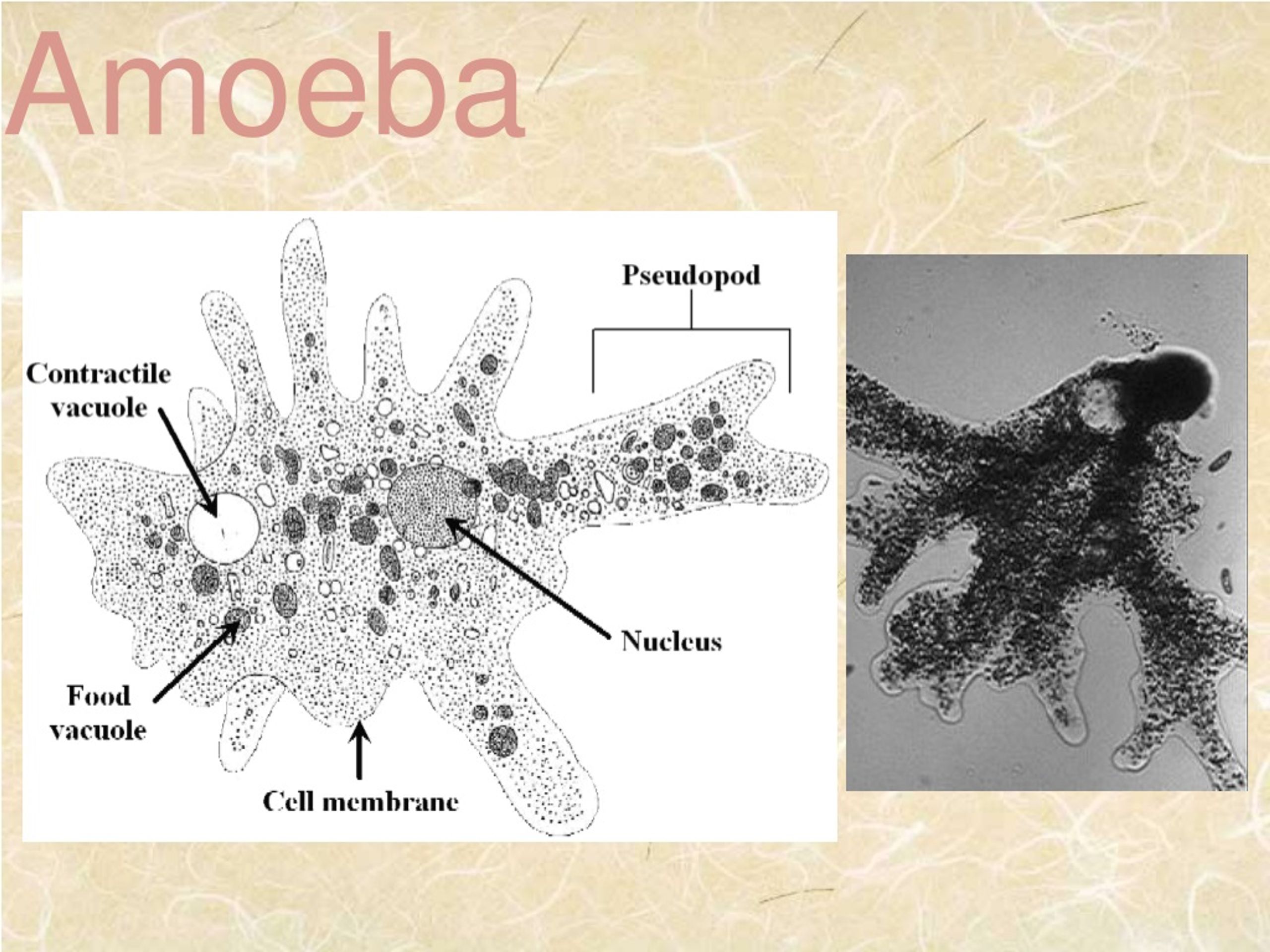
  1. Amoeba

  2. Paramecium

  3. Blepharisma The Blepharisma is a common ciliate found in most any pond. It is similar in size and shape to the Paramecium, but displays an unusual characteristic, albeit a potentially fatal one. It is easily spotted because, unlike most of its community pond inhabitants, it is not transparent, but rather a striking pink color under normal conditions. When exposed to an intense artificial light, such as that from a micro-projector, the pink pigment emits a poisonous toxin that completely disintegrates the creature. http://www.silkentent.com/gus1911/StuffText.htm

  4. Euglena

  5. Stentor The green color tone in this pair is probably due to the presence of symbiotic green algae http://www.silkentent.com/gus1911/BlueStent.htm

  6. Colpidium Eats bacteria ebiomedia.com/gall/ micronat/Colpidium.html

  7. Vorticella

  8. Chilomonas Chilomonas are very common and are one of the chief food sources for larger protozoans, especially Amoeba proteus. http://www.microscope-microscope.org/applications/pond-critters/protozoans/mastigophora/chilomonas.htm

  9. Didinium The Didinium is a protozoa that feeds exclusively on Paramecia. If a culture of Paramecia is innoculated with just two Didinium, the Didinium will wipe out the colony of Paramecia in just a few days, regardless of how large the culture is. It takes about one minute for the Didinium to consume a Paramecium, after which it moves on to consume another - sort of non-stop gluttony. The more they eat, the bigger they get, and the bigger they get the sooner they split into more of themselves. The Paramecia don't have a chance. http://www.silkentent.com/gus1911/StuffText.htm

  10. Volvox

  11. Spirostomum …Can grow to to a size of more than 4 millimetres. It can therefore be seen without the help of a microscope. When observed swimming in a little jar of pond water it looks like a little worm. The organism can contract it's body to 1/4 of it's length in 6-8 millisec which is the fastest contraction known in any living cell. …Feeds on bacteria. Like many large single celled organisms (giant amoebas, or Stentor: the trumpet animalcule) it has not one nucleus but many. The nucleii form a long strand, like a string of pearls. http://www.microscopy-uk.org.uk/mag/indexmag.html?http://www.microscopy-uk.org.uk/mag/artoct98/spiro.html

  12. Pond water Animals, NOT Protists… daphnia chaetonotus cypris macrothrix A rotifer cyclops rotifers hydra