
SlideServe
Menu
Préférences
© SlideServe · v2026

Ancient Roman Achievements

sef avatar
32 diapositives · 863 Views · Oct 11, 2014

Ancient Roman Achievements. Directions. Anything with a check mark next to it, you write on your Tree Map. If there’s no check mark, you don’t have to write it. Just read it and listen!. Barbaric, brilliant or both?.
Ancient Roman Achievements - slide 1
01 / 32Ancient Roman Achievements
1 / 17

Télécharger la présentation

Ancient Roman Achievements
Une image / un lien ci-dessous est fourni (tel quel) pour télécharger la présentation

Politique de téléchargement : le contenu du site vous est fourni TEL QUEL pour votre information et votre usage personnel ; il ne peut être vendu, concédé sous licence ni partagé sur d’autres sites sans l’accord de son auteur.Le contenu vous est fourni TEL QUEL, pour votre information et votre usage personnel uniquement. Téléchargez la présentation en cliquant sur ce lien. Lors du téléchargement, si vous ne parvenez pas à télécharger une présentation, l’éditeur a peut-être supprimé le fichier de son serveur.Pendant le téléchargement, si vous ne parvenez pas à obtenir une présentation, le fichier a peut-être été supprimé par l’éditeur.

F I N

Plus de contenu associé

Transcription de la présentation
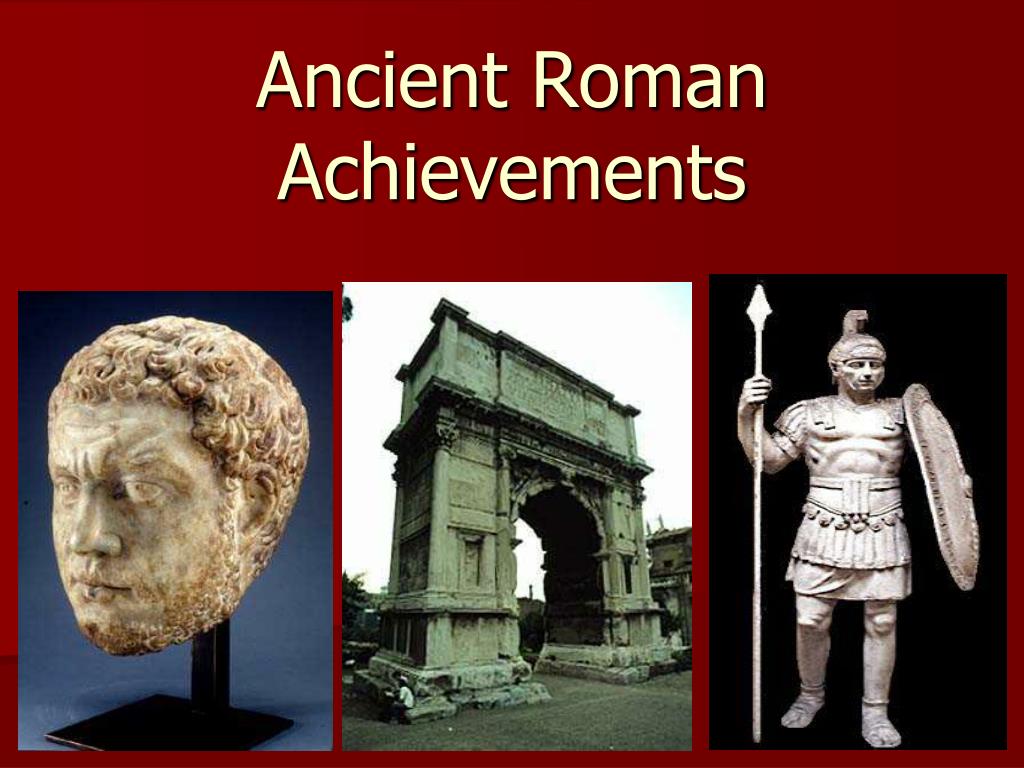
  1. Ancient Roman Achievements

  2. Directions Anything with a check mark next to it, you write on your Tree Map. If there’s no check mark, you don’t have to write it. Just read it and listen!

  3. Barbaric, brilliant or both? Romans were well know thieves. Although most of their ideas were stolen from other societies, Romans improved upon the stolen ideas and made them great!

  4. Art • Virgil depicted in a fresco

  5. Rome stole Greek art and copied their art style. • But Roman art was more realistic than Greek art

  6. Mosaics- art made out of small pieces of tile or stone to form a design.

  7. Frescoes- paintings on plaster Pompeii. Villa of the Mysteries

  8. The Romans painted murals. These depicted everyday scenes around Rome. They also painted mythological scenes such as the heroic deeds of Hercules, Achilles, Ulysses, and Theseus.

  9. As the Roman Empire became larger the Britons, Spanish, Carthaginians, Phoenicians, etc. mixed their art styles with the Romans styles to form many different styles throughout the Mediterranean area. Around 200 A. D. the German influence was first seen in the Roman art. At this time the art showed people suffering such as having their head cut off or their insides ripped out. The drill was invented making sculpting easier and faster. This gave the art a little different look. By the 300's A. D. Christianity influence began to show up in Roman art. The artwork had less blood and gore. Some figures were sculpted with the eyes looking towards heaven. At this time the body was less important. Sculptors took less time with the body and at times the body was not in the correct proportions.

  10. Architecture • Grandeur- being grand, the WOW! effect • Arches • Domes

  11. The Roman Pantheon- temple to all the Roman gods

  12. The Colosseum

  13. The Coliseum- a blend of Greek and Roman architecture • The arches are supported by central columns. • The columns on the first floor are Doric. • The columns on the second floor are Ionic. • The columns on the third floor are Corinthian.

  14. Victory arches The glorious Arch of Triumph in Rome, Italy.

  15. Arches of Triumph-to celebrate military success

  16. Engineering • Aqueducts- system of pipes or channels to bring water from its source to cities.

  17. Aqueducts

  18. Aqueducts- a way to carry water • There wasn’t enough water in the city of Rome. • The Romans brought water in from the surrounding countryside. • The water was brought in by tubes called aqueducts.

  19. Why arches? • Water is heavy stuff. • The Romans needed a structure strong enough to hold all that water to move it from the mountains into the city.

  20. Where did the water go? • The water was transported in concrete tunnels. • The tunnels were underground if possible. • Sometimes the tunnel had to go above ground.

  21. How did the aqueduct work? • The water flowed in a tube on the top of the aqueduct called a water channel. • The arches supported the water channel.

  22. What did the water channel look like? • The water flowed through a rectangular channel. • The channel was lined with concrete. • Romans invented concrete.

  23. How does an arch work?Keystones • The keystone is the red stone at the top of the arch. • The keystone is what the weight rests on.

  24. How does an arch work?Voussoirs • The semi-circular stones on either side of the keystone are the voussoirs. • The voussoirs bring the weight to the columns that go to the ground.

  25. Modern arches US Capital

  26. Public Bath houses

  27. Roads promoted trade. "All roads lead to Rome."  The Appian Way

  28. Bridge and dams The Roman dam at Hantes in Belgium. The thirteen small arches each have recesses for lifting cataractae (vertical lifting water doors).

  29. Literature • Latin is the root of many modern languages. • Virgil wrote the Aeneid • Ovid wrote the Metamorphoses

  30. History • Livy- a patriotic Roman historian • Tacitus- criticized Roman emperors in his writings

  31. Law • Civil law- laws that applied to all citizens • Law of Nations- laws that applied to all who lived in Rome • Roman ideas helped shape Western legal systems