Plenary Session: Geographic Mapping Instructions
Join our plenary session on geographic mapping instructions tailored for health ministries and NGOs. This session focuses on identifying and categorizing service providers using flag pins to designate capacities for family planning methods—ranging from national to regional levels. Participants will engage in discussions about target populations, service delivery locations, and types of family planning methods offered. The workshop will highlight the importance of technical assistance in enhancing service delivery, especially for adolescents. Help us improve health outcomes through effective geographic mapping!

Plenary Session: Geographic Mapping Instructions
E N D
Presentation Transcript
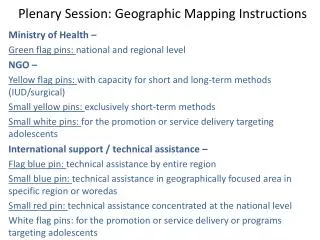
Plenary Session: Geographic Mapping Instructions Ministry of Health – Green flag pins: national and regional level NGO – Yellow flag pins: with capacity for short and long-term methods (IUD/surgical) Small yellow pins: exclusively short-term methods Small white pins: for the promotion or service delivery targeting adolescents International support / technical assistance – Flag blue pin: technical assistance by entire region Small blue pin: technical assistance in geographically focused area in specific region or woredas Small red pin: technical assistance concentrated at the national level White flag pins: for the promotion or service delivery or programs targeting adolescents
Plenary Session: Geographic Mapping Instructions Cont. Service providers answer following questions: Population that your institution/programs serves. Do you have target populations (i.e. in terms of socio-economic level, age, etc.)? Describe the geographic focus of your programs (i.e. urban, semi-urban, rural, woreda, community level, etc.) Type and brands of methods offered Family planning service provided by level of care Special services/programs offered (i.e. IEC, education, advocacy, etc.) Technical assistance providers answer following questions: Population that your institution/programs serves. Do you have target populations (i.e. in terms of socio-economic level, age, etc.)? Describe the geographic focus of your programs (i.e. urban, semi-urban, rural, woreda, community level, etc.) Special services/programs offered (i.e. IEC, education, advocacy, etc.)