Download
1 / 13
130 likes | 250 Vues
The Cornell Note-Taking System, developed by Walter Pauk over fifty years ago, is an efficient method for organizing notes during lectures and reading. This system emphasizes a structured approach using a cue/question column, enabling students to actively engage with the material. The five phases of note-taking—Record, Reduce, Recite, Reflect, and Review—guide learners in capturing essential points and reinforcing memory. By incorporating telegraphic sentences and weekly reviews, students can enhance their comprehension and retention, crucial for academic success and standardized testing.

E N D
Cornell Systemof Notes Based on Powerpoint by W. Hawley at Los Amigos High School, Fountain Valley, CA and Essential Study Strategies by Walter Pauk, H&H Publishing, Clearwater, FL, 2000
What is the Cornell System? The Cornell System is a method for note taking that was developed by Walter Pauk more than fifty years ago at Cornell University.
Basic Note Taking Skills: Allotment of Time During a lecture: 80% of the time listening to the speaker, 20% of the time writing notes While reading: 80% of the time reading the text, 20% of the time writing notes
Basic Note Taking Skills: Telegraphic Sentences Lecturer’s Actual words: At Gettysburg, was fought the most decisive battle of the Civil War, marking the turning point of the struggle between North and South. Student’s Telegraphic Sentence: Gettysburg-most decisive battle-turning point
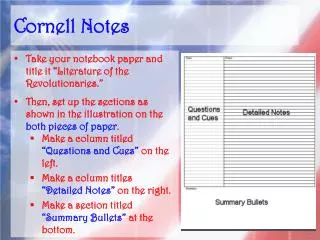
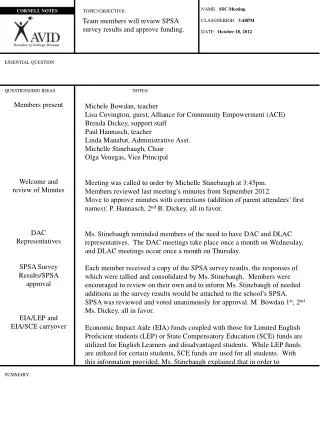
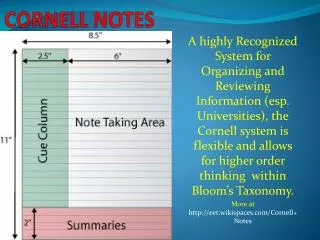
How does it work? The secret of the Cornell System is the cue/question column, a 2½ inch margin at the left-hand side of each notebook page. It can be drawn in fairly easily with a ruler and pencil.
The Cue/ Question Column
The 5 Phases of the Cornell System • Record • Reduce • Recite • Reflect • Review 5 “Rs”
In the note-taking column, record as many meaningful facts and ideas as you can. Use telegraphic sentences. This occurs during the lecture or reading.
12-3-04 Write the date at the top of the note-taking column. Gettysburg-most decisive battle-turning point Lee’s army-many casualties Vicksburg-Union controls Mississippi River-rise of Grant/Sherman Leave spaces between key ideas. At least three lines. Gettysburg Address- Lincoln’s new vision of America-”…a new birth of freedom…”
12-3-04 After class,reduce your notes to short cues or questions and place these in the cue/question column. Gettysburg-most decisive battle-turning point Lee’s army-many casualties Gettysburg Why was the Vicksburg victory important? Vicksburg-Union controls Mississippi River-rise of Grant/Sherman How and why questions are better. Think at higher levels! Gettysburg Address- Lincoln’s new vision of America-”…a new birth of freedom…” Transcendent moment at Gettysburg
12-3-04 Cover the note-taking column with a planner or piece of paper. Looking at the cue/ question column, recite aloud and in your own words the full lecture or reading. Gettysburg Why was the Vicksburg victory important? Transcendent moment at Gettysburg
12-3-04 Reflect upon the significance of the information in the lecture or reading. What principles are they based on? How can I apply them? What’s beyond them? Place the reflection in the reflection/summary area at the bottom of the page. Gettysburg-most decisive battle-turning point Lee’s army-many casualties Gettysburg Why was the Vicksburg victory important? Vicksburg-Union controls Mississippi River-rise of Grant/Sherman Gettysburg Address- Lincoln’s new vision of America-”…a new birth of freedom…” Transcendent moment at Gettysburg In the summer and fall of 1863, the military initiative dramatically shifted in favor of the North. A broader vision of freedom begins totake hold.
Reviewall notes every week. The chances of remembering instruction for the AP Exam or for a lifetime greatly diminish without review. The review consists of again covering the note-taking column and reciting the lecture or reading using the cues or questions.