Understanding Special Cases in Solving Linear Equations
This guide focuses on special cases encountered when solving linear equations with two variables. It outlines the steps to determine whether a system of equations has no solutions or infinitely many solutions. The special cases discussed include scenarios where variables cancel each other out leading to false statements, indicating no solutions, and scenarios that simplify to true statements, indicating infinitely many solutions. Students are encouraged to practice additional problems to reinforce learning.

Understanding Special Cases in Solving Linear Equations
E N D
Presentation Transcript
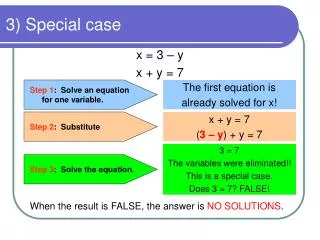
3) Special case x = 3 – y x + y = 7 Step 1: Solve an equation for one variable. The first equation is already solved for x! Step 2: Substitute x + y = 7 (3 – y) + y = 7 3 = 7 The variables were eliminated!! This is a special case. Does 3 = 7? FALSE! Step 3: Solve the equation. When the result is FALSE, the answer is NO SOLUTIONS.
3) Special Case 2x + y = 4 4x + 2y = 8 Step 1: Solve an equation for one variable. The first equation is easiest to solved for y! y = -2x + 4 4x + 2y = 8 4x + 2(-2x + 4) = 8 Step 2: Substitute 4x – 4x + 8 = 8 8 = 8 This is also a special case. Does 8 = 8? TRUE! Step 3: Solve the equation. When the result is TRUE, the answer is INFINITELY MANY SOLUTIONS.
You Try: 2. 6x – y = 31 4x + 3y = 17 1. x + 2y = 2 5x - 3y = -29
Homework Pg 313 #2 to 16 even Pg 314 #32, 34 (do not graph)