Download
1 / 8
80 likes | 198 Vues
Flow rate in water systems is influenced by potential difference, resistance, and permeability. Water flows from areas of high potential to low potential, and a high flow rate can generate substantial power. Key factors affecting resistance in water pipes include cross-sectional area, the presence of obstacles like sand or gravel, pipe length, and viscosity. In electrical systems, conductance relates directly to the wire's area and material conductivity. Understanding these principles helps in optimizing flow in both fluid and electrical circuits.

E N D
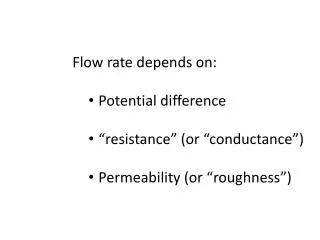
Flow rate depends on: • Potential difference • “resistance” (or “conductance”) • Permeability (or “roughness”)
Water flows from high potential to low potential High potential Same high potential Lower potential A high flow rate generates lots of power
In a water pipe:“resistance” is determined by… • Area: • Inversely proportional in pipes with obstacles • Is the pipe full of sand? gravel? large rocks? • Inversely prop. to area2 in hollow pipes • Inversely prop. to permeability of obstacles if any (sand, gravel…) • Length (directly proportion) • Viscosity (directly proportion) • The opposite of Conductance is • “RESISTANCE” = 1/conductance
In an electric wire or light bulb:“conductance” is proportional to (area x conductivity)/length • Area (size of “wire” or “filament”) • Conductivity (the current must flow around atoms in the wire) • The opposite of Conductance is • “RESISTANCE”