Advancements in Optoelectronics Packaging: Research Insights and Development Strategies
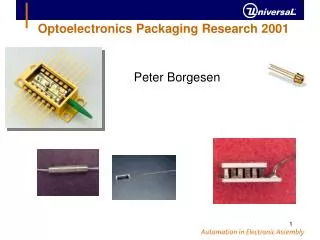
This comprehensive research report by Peter Borgesen, Project Manager in Optoelectronics Packaging, highlights the teardown analysis of active and passive components to identify design improvements and assembly practices. It covers optical fiber processes such as cleaving, splicing, and damage testing, along with the fundamental metallurgy of soldering and assembly process development. The report also examines advanced techniques in flip chip VCSEL bonding and selective soldering for enhanced reliability. Ultimately, it aims to characterize damage mechanisms and optimize materials for robust packaging solutions.

Advancements in Optoelectronics Packaging: Research Insights and Development Strategies
E N D
Presentation Transcript
Optoelectronics Packaging Research 2002 Peter Borgesen Project Manager
Teardown,Product Development, • Prototype Assembly Identify potential improvements to current designs and assembly practices, as well as generic problems to be researched, through ‘teardown’ analysis of active and passive components working with manufacturers to solve individual process and design problems and, in some cases, develop complete products building generic model components, assembling these into corresponding ‘prototype products’
Optical Fibers Cleaving, stripping, splicing, pigtailing, connectorization of SMFs, DSFs, EDFs, PM fibers Damage & Failure: Develop test & data interpretation (‘life in service’) Optimize above processes Specs
AuSn Soldering Fundamental metallurgy (phases, kinetics) for different reflow profiles, contact pad and solder structures (predeposited, composition, multilayers) Materials properties vs. reflow profile & metallurgies Assembly process development Scrubbing, pressure, ambient Multilayer design
Adhesives Deposition -- reproducibility & location control Pin transfer, dispensing, dipping Dependence of cure kinetics on dimensions & configuration Dependence of properties on cure, dimensions & configuration Creep, moisture uptake & permeability, adhesion, optical performance
Flip Chip VCSEL Bonding of Au-bump die Thermocompression Adhesive (dipping, printing)
Selective Soldering Automatable process for soldering of butterfly packages etc to PCB Solder (paste) deposition Reflow process parameters Intermetallic formation (embrittlement) Dependence on package (Au) supplier?
Qualification, Robustness, Reliability Telcordia: How do we pass? What are we missing? Characterize damage and failure of model structures in specified tests Develop faster (screening) tests for process & materials optimization Identify realistic damage mechanisms and check if these are properly accelerated Assess effects of mechanisms not addressed.