Download
1 / 13
130 likes | 263 Vues
The lymphatic and immune systems work together to protect the body against infectious diseases caused by various pathogens, including viruses, bacteria, fungi, and protozoa. The lymphatic system is composed of lymphatic vessels and organs like the spleen and thymus, facilitating the transport of lymph and playing crucial roles in immune response. It employs both non-specific (such as skin and stomach acid) and specific mechanisms (like antibody production) to counter infections. This system is vital for maintaining homeostasis and defending against illnesses.

E N D
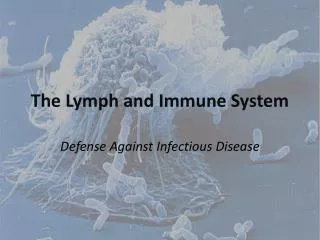
The Lymph and Immune System Defense Against Infectious Disease
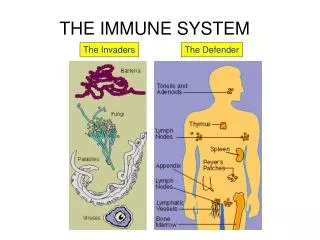
Pathogens • Defined as any living organism or virus that is capable of causing disease is called a pathogen • Include • Viruses • Bacteria • Protozoa • Fungi • Various worms
The Lymphatic System • Consists of two semi-independent parts • Lymphatic vessels • Lymphoid tissues and organs • Lymphatic system functions • Transport fluids back to the blood • Play essential roles in body defense and resistance to disease
The Lymphatic System • Lymph – excess tissue fluid carried by lymphatic vessels • Properties of lymphatic vessels • One way system toward the heart • No pump • Lymph moves toward the heart • Milking action of skeletal muscle • Rhythmic contraction of smooth muscle in vessel walls
The Lymphatic System • Lymphatic collecting vessels • Collects lymph from lymph capillaries • Carries lymph to and away from lymph nodes
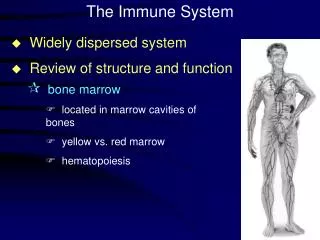
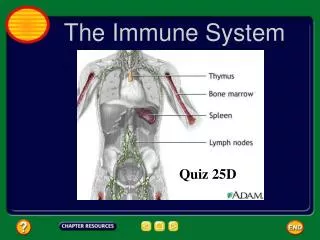
Lymphatic Organs • Several other organs contribute to lymphatic function • Spleen • Thymus (sweet breads) • thymosin • Tonsils • Peyer’s patches
Preventing Pathogens from Entering the Body • Non-Specific Immune Mechanisms • Skin • Primary outer defense • Dermis layer contains phagocytes • Stomach acid • Acidic environment kills most pathogens • Mucous membranes • Goblet cells create mucus and enzyme called lysozyme • Saliva and lacrimal glands produce lysozyme too
If/When Pathogens Get In: Specific (i.e., Immune System) • Homeostatic Imbalance or Illness: Viral/Bacterial load exceeds the body’s ability to defend • White Blood Cells (WBC’s/Phagocytic Leukocytes) • Macrophages are 1st line of defense • Identify “self” or “non-self” via protein identification (antigens) • Called a non-specific response
Antibody Production • Produced by B lymphocytes in response to a specific pathogen • All pathogens have unique antigen combinations on the surface of their cells • Antibodies are ‘Y’ shaped protein molecules that have binding sites for these specific antigens on the open end • Antibodies bind to pathogen • Identifies it for disposal by body • Does not allow it to reproduce (bacteria) or bind to host cell (virus)
Steps of Immune Response (vaccination/immunizations) • 1. A specific antigen type is identified • 2. Specific B lymphocyte is identified that will produce an antibody that will bind to antigen • 3. B lymphocyte and other identical B lymphocytes rapidly clone themselves (mitosis) to increase lymphocyte count • 4. Lymphocytes begin antibody production • 5. Antibodies circulate in blood to find antigen match • 6. Antibodies attach and help eliminate pathogen • 7. Some antibodies remain in bloodstream and provide immunity (memory cells)
HIV, AIDS and the Immune System • Human immunodeficiency virus (HIV) has antigen binding site that binds to helper-T cells • Helper-T cells communicate via bloodstream as to which cells need to undergo cloning in order to begin antibody production • Without helper-T cells, antibody production cannot take place and no immunities develop • Secondary infections cause Acquired Immunodeficiency Syndrome and eventual death
Types of Immunities • Active • Production of antibodies by organism itself • Passive • Acquisition of antibodies from another organism • Natural immunity • Immunity due to infection/acquisition from mother • Artificial • Due to vaccine inoculation/antibodies
Antibiotics v. Bacteria and Viruses • Antibiotics are chemicals that take advantage of the differences between prokaryotic and eukaryotic cells with respect to the chemical pathways within the cell • Some block protein synthesis in prokaryotic cells but eukaryotic cells (yours) • Others inhibit bacterial cell walls • For these same reasons, viruses are not affected because they utilized out eukaryotic cells for replication • Cytotoxic T-cells • Destroy virus infected cells in the body • Interferon

![The Lymphatic & Immune Systems [Latin: lymph = water ; immune = safe]](https://cdn0.slideserve.com/1441826/the-lymphatic-immune-systems-latin-lymph-water-immune-safe-dt.jpg)