Understanding Elements, Compounds, and Crystal Structures: Key Concepts in Chemistry
10 likes | 126 Vues
This text explores the classification of substances as elements or compounds and differentiates metals from nonmetals. It covers various types of crystal structures, including covalent and ionic crystals, and discusses how bond strength is influenced by atomic size, charge, and molecular interactions. The significance of polar and nonpolar molecular crystals, as well as the role of Van der Waals forces and hydrogen bonding, is also highlighted. Understanding these concepts is essential for grasping the behaviors and properties of different materials in chemistry.


Understanding Elements, Compounds, and Crystal Structures: Key Concepts in Chemistry
E N D
Presentation Transcript
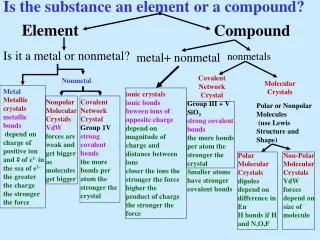
Is the substance an element or a compound? Is it a metal or nonmetal? Element Compound metal+ nonmetal nonmetals Covalent Network Crystal Group III + V SiO2 strong covalent bonds the more bonds per atom the stronger the crystal Smaller atoms have stronger covalent bonds Nonmetal Molecular Crystals Metal Metallic crystals metallic bonds depend on charge of positive ion and # of e1- in the sea of e1- the greater the charge the stronger the force ionic crystals ionic bonds beween ions of opposite charge depend on magnitude of charge and distance between ions closer the ions the stronger the force higher the product of charge the stronger the force Nonpolar Molecular Crystals VdW forces are weak and get bigger as molecules get bigger Covalent Network Crystal Group 1V strong covalent bonds the more bonds per atom the stronger the crystal Polar or Nonpolar Molecules (use Lewis Structure and Shape) Polar Molecular Crystals dipoles depend on difference in En H bonds if H and N,O,F Non-Polar Molecular Crystals VdW forces depend on size of molecule