Developing Leaders for Tomorrow: Insights from The West Point Story
280 likes | 375 Vues
Explore the psychology of leadership at Harvard College through the lens of The West Point Story. Discover the evolving role of leadership in organizations, focusing on retention and cultivation. Delve into effective leadership strategies and the barriers to learning and change.


Developing Leaders for Tomorrow: Insights from The West Point Story
E N D
Presentation Transcript
Leadership Cultivation Organizations: Retention Psychology of Leadership March 2006 Sources: General Service Administration, Dept of the Army Historical Summary FY89, OMF, USMA Graduate File
Why are you here? . . . today? . . . in Psychology of Leadership? . . . at Harvard College? . . . on this planet?
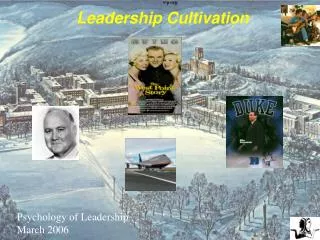
The World Changed Now What? “The West Point Story” or What kind of leadershave we developed? and What kind of leaderswill we need?
VIDEO 1 1950 v. 1990 v. ?
VIDEO 2 1950 v. 1990 v. ?
USMA Mission To educate, train, and inspire the Corps of Cadets so that each graduate is a commissioned leader of character committed to the values of Duty, Honor, Country; professional growth throughout a career as an officer in the United States Army; and a lifetime of selfless service to the Nation.
USMA Mission To educate, train, and inspire the Corps of Cadets so that each graduate is a commissioned leader of character committed to the values of Duty, Honor, Country; professional growth throughout a career as an officer in the United States Army; and a lifetime of selfless service to the Nation.
Development (Who you ARE) BE KNOW DO Education (What you KNOW) Training (What you DO) Planned Change: ? INSPIRE INSPIRE People
Even in War, Under the worst of conditions. . . People can be creative and have some fun!
Even in War, Under the worst of conditions. . . People can be creative and have some fun!
“The largest developmental impact was raising the positive beliefs of followers, instilling in them the conviction that they were better at a performance task than they thought.” (Avolio & Luthans, 2006) Gallup Leadership Institute Study: Meta-analysis of all leadership development intervention Studies published in the past 100 years.
Conventional Wisdom:self-awareness is a good thing; people who have a realistic assessment of their strengths and weaknesses outperform those whose assessments are inflated; in short, unrealistic self-confidence leads to a fall. (Buckingham, 2005)
Current Research:suggests that accurate self-awareness rarely drives performance, and that in many circumstances, it actively retards performance. Only self-assurance drives performance, even when this self-assurance turns out to be unrealistic. (Buckingham, 2005)
Your job is NOT to provide your people with a realistic picture of the limits of their strengths and the liabilities of their weaknesses—you’re a manager, not a therapist. Your job is to get them to perform. (Buckingham, 2005)
In short, the state of mind you should try to create in them is one where they have a fully realistic assessment of the difficulty of the challenge ahead of them, and, at the same time, an unrealistically optimistic belief in their ability to overcome it. (Buckingham, 2005)