Understanding Vector Components: Decomposing and Analyzing Forces
70 likes | 249 Vues
This article delves into the concept of vector components, explaining how to break down a vector into its perpendicular components using trigonometric relationships. With practical examples, such as calculating force vectors and displacement movements, we will explore how to find the x, y, and z components of vectors. Learn to apply the component method to compute the resultant of multiple displacement vectors, enhancing your understanding of vector analysis in physics.


Understanding Vector Components: Decomposing and Analyzing Forces
E N D
Presentation Transcript
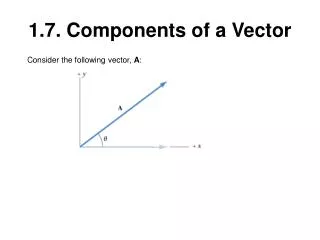
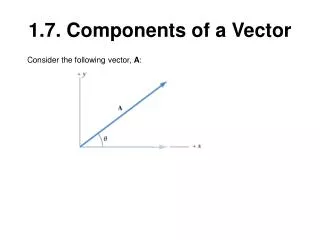
1.7. Components of a Vector Consider the following vector, A:
1.7. Components of a Vector Consider the following vector, A: How can we replace vector A by two perpendicular components?
1.7. Components of a Vector Aadj=A∙Cos θ and Aopp=A∙Sin θ
Problem-39 The drawing shows a force vector that has a magnitude of 475 N. Find the (a) x, (b) y, and (c) z components of the vector.
Vector Components A jogger runs 145 m in a direction 20.0° east of north (displacement vector A) and then 105 m in a direction 35.0° south of east (displacement vector B).
Problem Find the resultant of the three displacement vectors in the drawing by means of the component method. The magnitudes of the vectors are A = 5.00 m, B = 5.00 m, and C = 4.00 m.