Understanding Slope: Types, Definitions, and Formulas
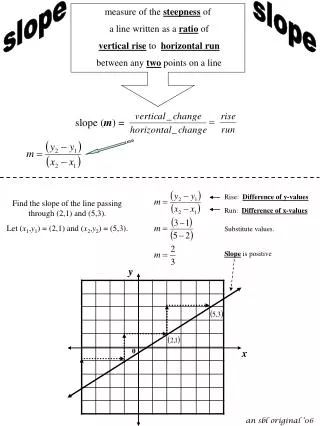
Slope is a numerical value, often expressed as a fraction, indicating the direction a line slants. There are four main types of slope: positive, negative, zero, and undefined. Positive slopes indicate a line that rises uphill, while negative slopes represent lines that decline downhill. Horizontal lines have a slope of zero, and vertical lines have an undefined slope. The slope is commonly abbreviated as 'm' in mathematical formulas, which is pivotal in understanding linear equations and their graphical representations.

Understanding Slope: Types, Definitions, and Formulas
E N D
Presentation Transcript
Slope • is a number • usually a fraction • that tells how a line slants • comes in 4 “flavors”: • positive, negative, zero, undefined
Slope Lines that slant uphill have a POSITIVE slope. Lines that slant downhill have a NEGATIVE slope.
Slope Horizontal lines have a slope of zero (0). Verticallines have no slope (undefined).
Slope Is a number Usually a fraction That tells how a line slants Slope is abbreviated with a lower case letter m.
Slope NOTE: Line slants downhill, so the slope is negative.
Slope NOTE: Line slants uphill, so the slope is positive.