Understanding Project Exit Strategies: Options and NPV Implications
This text discusses the dynamics of project exit strategies, emphasizing how each project generates and eliminates options over time. It highlights that waiting affects the potential to reassess and possibly re-enter, while exiting prematurely diminishes future exit opportunities. The analysis points out that Net Present Value (NPV) calculations can lead to suboptimal decisions, and the concept of Real Options (RO) enables participants to optimize outcomes by balancing potential gains with limited downside risks. Relevant examples illustrate these concepts.

Understanding Project Exit Strategies: Options and NPV Implications
E N D
Presentation Transcript
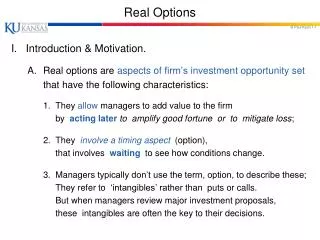
Real Options II Recall that every project creates and destroys options. Waiting focuses on the destruction of the option to take the same project in the future. The converse is the decision to exit. By exiting now, we destroy the option of exiting in the future. The simplest intro to exiting is to consider that we are currently in the business.
Exit (Cont’d.) • But also recognize that valuable exit option makes it more appealing to take on a project. (Problem Set 3 has an example of this.) • Once again NPV may give bad recommendations (Exit too soon). • NPV averages over the future. RO recognizes that we can participate on the up-side & limit down-side exposure.
Exit (Cont’d.) • See Dixit & Pindyck, bottom of p. 108 - top of 109. • May appear to be the sunk-cost mistake, but it’s not. • Quantitative Example: Exit1.xls (Course Page). • Notes similar to Waiting Example.