Download
1 / 22
220 likes | 395 Vues
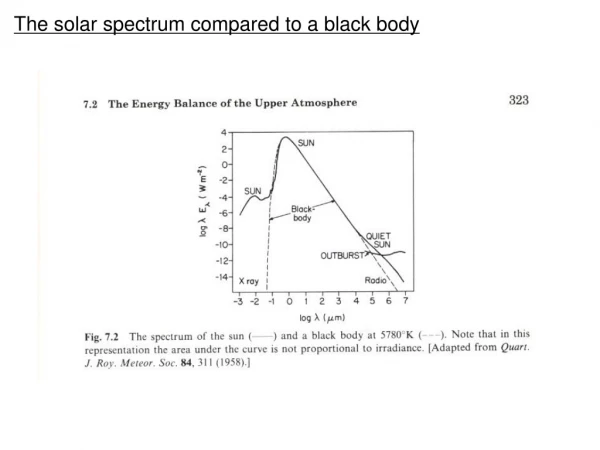
This presentation explores the solar spectrum in relation to black body radiation, comparing the radiation curves of the Sun (~6000K) and Earth (~290K). It illustrates how the Sun emits significantly more energy than Earth, with minimal overlap in their normalized radiation curves. The fluctuations in solar output are also examined through measurements from various sources and the implications for climate. The role of atmospheric gases like CO2 and H2O in absorbing and re-emitting infrared radiation, contributing to the greenhouse effect, is emphasized, underscoring their importance in Earth's energy balance.

E N D
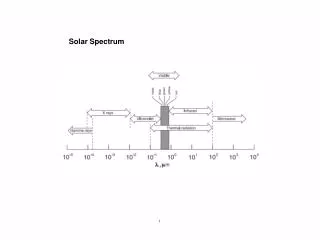
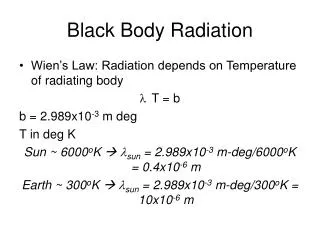
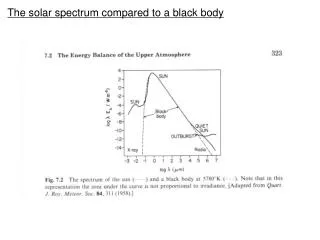
Blackbody radiation curves typical for the Sun and Earth Sun ~6000K Earth ~290K Sun radiates a lot more energy that the Earth!
Normalized blackbody radiation curves for Earth and Sun • Divide each radiation curve by its maximum value • to normalize curves: • Very little overlap of the normalized radiation curves
How steady is the Sun’s output? • Measurements of solar radiation from space, • rockets, and balloons • Note on short timescales, some large fluctuations are possible. C. FRÖHLICH IPCC, 2001
Reconstructions of solar variability over time TSI = total solar irradiance Note the scientific trend too… IPCC, 2001
How do we get these temperatures? -Infrared temperatures from Aqua satellite, April 2003.
Reflectivity (albedo) of Solar (shortwave) radiation September, 2005 smsc.cnes.fr/IcPARASOL Global average ~30% Albedo increases with latitude Oceans are quite dark (low reflectivity)
Emissivity of infrared radiation at the surface cimss.ssec.wisc.edu/iremis/ Emissivity, e, is a measure of how well blackbody radiation is obeyed: F=esT4 Emissivity/absorptivity is close to 1. This implies a good approximation to black body in the infrared
Summary (important)- At visible wavelengths, the Earth reflects about 30% of the incident radiation. At infrared wavelengths, most natural materials absorb almost Everything (~95 to 98%), so the Earth behaves quite closely as a true blackbody. -Go to calculation of black body temperature
Radiation and physical objects Any physical material (solid, liquid, gas) interacts with electromagnetic waves (radiation) in one of four different ways. TRANSMISSION: waves pass through the material ABSORPTION: some of the waves are absorbed (& heat) REFLECTION: some of the waves are reflected in the direction they came from. EMISSION: Every object (above absolute zero) emits radiation because it possesses thermal energy Less important:- SCATTERING: waves are deflected (hence blue sky…)
Radiation and physical objects How a material interacts with radiation (transmission, absorption, emission, reflection) depends on what it is made of. For example: what’s the difference between the yellow light in these 3 pictures?
A key fact for Earth’s climate is that gases in the atmosphere absorb radiation. • Molecules absorb radiation at particular wavelengths, depending on amount of energy required to cause vibration or rotation of atomic bond. • Two essential things for the greenhouse effect: • The Earth’s atmosphere is mostly transparent to visible radiation (why not totally) • The Earth’s atmosphere is mostly opaque to infrared radiation.
The composition of the Earth’s atmosphere matters... (Plus other trace components, e.g. methane, CFCs, ozone) • Bi-atomic molecules (O2, N2) can only absorb • high energy photons, meaning ultraviolet • wavelengths and shorter. • Tri-atomic molecules (H2O, CO2) can absorb • lower energy photons, with wavelengths in the • infrared
Atmospheric absoption by atmospheric constituents solar & terrestrial emissions as a function of wavelength 100%- CH4 N20 O2,03 CO2 H20 0%- Peixoto and Oort, 1992
Key things from previous slide:- • Atmosphere mostly transparent to solar radiation (except in uv) • Atmosphere mostly opaque to terrestrial radiation (infrared) • Water vapor is the most important greenhouse gas (by far) • Carbon dioxide is a problem because of a ‘window’ in H2O • absorption spectrum. • This physics is very, very well known
Atmospheric absorption • Shortwave (i.e. solar) radiation measured from the top of • atmosphere and from the ground. • The (clear) atmosphere is not totally • transparent to solar radiation: • back scatter by dust, aerosols • absorption by constituent gases • amount varies as a function of • wavelength Peixoto and Oort, 1992
Energy pathways in the atmosphere IPCC, 2007
Greenhouse effect summary • CO2 and H20 (and some other gasses) effectively absorb radiation at the same wavelengths that the Earth • emits at. • Some of that radiation is then re-emitted back towards the ground keeping the surface warmer than it would otherwise be. Essential to remember: - CO2 , H20 in the atmosphere absorbs and re-emits infrared radiation - It does NOT (not, not, not) reflect radiation