DNA and Mutations
Explore essential facts about mutations in DNA and their impact on health. This overview describes three main types of mutations: substitution, insertion, and deletion, each illustrated by real-world examples like sickle-cell anemia and Duchenne muscular dystrophy. Discover how mutations can lead to altered proteins and various genetic disorders, including Down syndrome and Turner’s syndrome. We will also delve into the concept of epigenetics, examining how identical twins can exhibit different traits despite having the same DNA sequence.

DNA and Mutations
E N D
Presentation Transcript
5 Mutation Facts • Write down five facts about mutations as we go through the following videoclips • Video 1 • Video 2 – Repair • Video 3 – Repair • Addition and Deletion Mutations
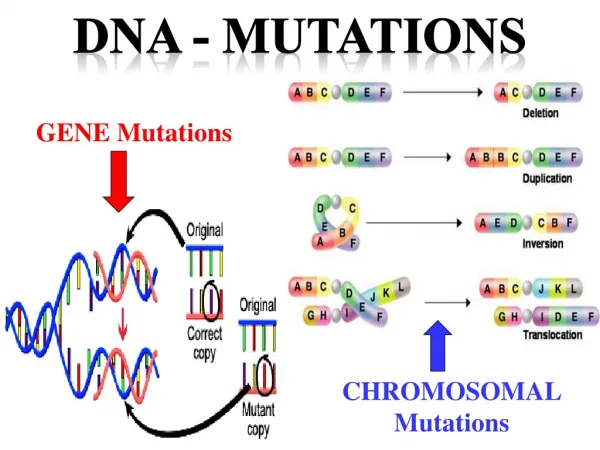
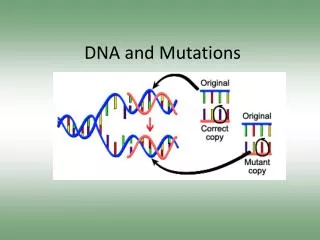
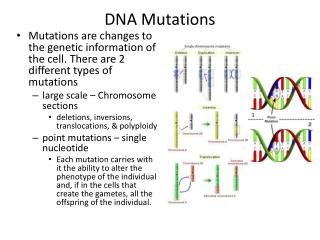
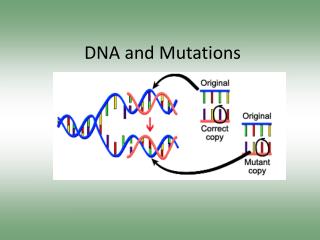
Mutation = change in the DNA code • Lead to frameshifts – the message is no longer correctly passed = protein altered (changed, no change, or incomplete)
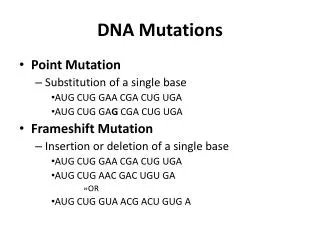
3 Types of DNA Mutations: 1. • 1. Substitution - one base for another • Ex: Sickle-cell Anemia • GAG (Valine) into GUG (Glutamic acid)
2. • 2. Insertion - extra bases • Ex: Fragile X syndrome – CGG repeat • 5-100 repeats = no harm • longer repeats grow longer from one generation to the next (as many as 4000 repeats).
3. • 3. Deletion- a section of DNA is lost Ex: Duchenne Muscular Dystrophy (DMD) • DMD gene codes for dystrophin (protein) • protein holds skeletal muscle cells together • DMD = no protein to bind muscle cells together
Chromosome Mutations • Chromosome: Coiled DNA and proteins Karyotype
Chromosome 21 “Trisomy 21’ Down Syndrome
Kleinfelter’s Syndrome- XXY • Male • Develop some breast tissue • Little body hair • typically tall • Infertility results - no sperm
Turner’s Syndrome – X • No Y means Turner’s people are female. • no ovaries develop don’t undergo puberty and they are sterile. • Hormone treatment cures all but the sterility. • Other symptoms: short stature, webbed skin and low hairline at the neck
Reflection • DNA codes for proteins. If DNA is mutated, how might this cause a disease? (Connect proteins to disease). • How is it possible for two identical twins, with identical DNA sequences, have different traits – for instance one gets cancer and one does not.
What is Epigenetics? • the study of changes in phenotype (appearance) or gene expression caused by mechanisms other than changes in the DNA