Understanding Viruses and Bacteria: Essential Insights into Infectious Agents
This informative piece by Thomas and Brandon explores the fundamental differences between viruses and bacteria. Viruses are defined as small infectious agents that only replicate inside host cells. In contrast, bacteria are unicellular, prokaryotic organisms that reproduce by fission and can be classified into two types: Eubacteria and Archaebacteria. The text also highlights notable examples, including the highly contagious smallpox virus, characterized by fever and skin eruptions, and Streptococcus, a Gram-positive bacterium responsible for diseases like scarlet fever and tonsillitis.

Understanding Viruses and Bacteria: Essential Insights into Infectious Agents
E N D
Presentation Transcript
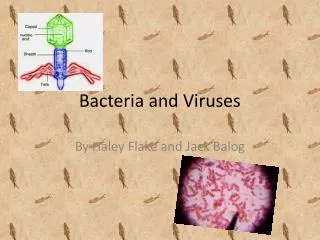
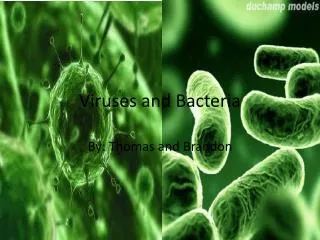
Viruses and Bacteria By: Thomas and Brandon
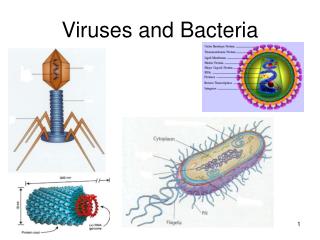
Virus • A small infectious agent that can replicate only inside the cells of other organisms.
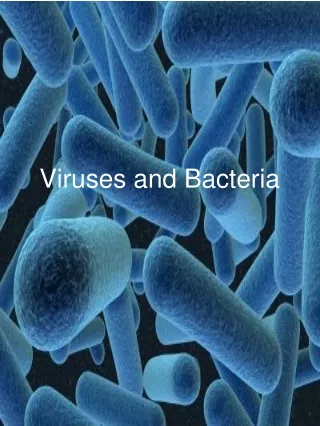
Bacteria • Single-celled or noncellular spherical or spiral or rod-shaped organisms lacking chlorophyll that reproduce by fission.
Bacteria • Prokaryote • Unicellular • Heterotroph • 2 types • Eubacteria and Archaebacteria • Shapes • Spirilla, Bacilli, and Cocci
Smallpox • A highly contagious viral disease characterized by fever and weakness and skin eruption with pustules that form scabs that slough off leaving scars
Streptococcus • Spherical Gram-positive bacteria occurring in pairs or chains and causes scarlet fever and tonsillitis