Understanding Market Equilibrium: Demand, Supply, and Competitive Dynamics
120 likes | 244 Vues
This guide explores the concept of market equilibrium, where the forces of supply and demand meet. It explains how market demand is derived from the sum of individual demands and how market supply is calculated from individual suppliers. The competition among demanders and suppliers plays a crucial role in price adjustments. The document also covers excess supply and demand scenarios, minimum wage implications, and rent control issues, highlighting their effects on market equilibrium. Gain insights into how various factors influence prices and quantities in a competitive market.


Understanding Market Equilibrium: Demand, Supply, and Competitive Dynamics
E N D
Presentation Transcript
The Market Equilibrium(One More Time) ■ Market demand and supply ■ Bring together suppliers and demanders ■ Equilibrium
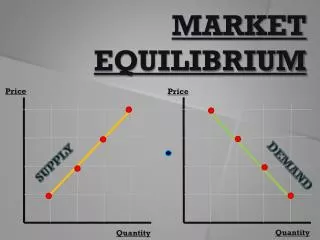
Market Demand Is the Sum of All Individual Demands At each price, sum the individual quantities demanded, Da, Db … Dn, to get market quantity demanded (Dm) P P P Dm = ∑ Da + Db + . . . Dn + = P1 P1 P1 Dm Da Db P2 P2 P2 Q1 Q2 Q1 Q2 Q1 Q2
Market Supply Is the Sum of All Individual Suppliers At each price, sum the individual quantities supplied to get market quantity supplied (Sm) P P P Sm = ∑ Sa + Sb … Sn Sb Sa P1 P1 P1 + = Sm P2 P2 P2 Q1 Q2 Q1 Q2 Q1 Q2
Competition ■ Demanders compete with each other to get goods. Their efforts push price up, enriching suppliers. ■ Suppliers compete with each other to attract customers. Their efforts push price down, enriching demanders. ■ Demanders do NOT compete with suppliers, even thought it sometimes seems that way! They are bargaining: Each party tries to convince the other of the powerful competition faced by alternatives.
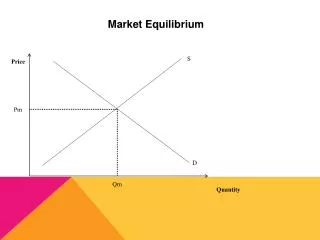
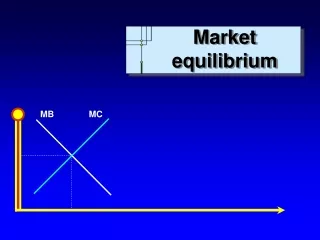
Equilibrium: Competition means mutually beneficial cooperation At “equilibrium” no one has an incentive to change behavior: Price S P* D Q/time Q*
Adjustments to equilibrium ■ Price above P* ► Quantity supplied exceeds quantity demanded: excess supply, or “surplus” ► Frustrated suppliers compete for business, lowering prices (“buyers’ market”) ► Price falls until market clears ■ Price below P* ► Quantity demanded exceeds quantity supplied: excess demand, or “shortage” ► Frustrated demanders compete for product, raising prices (“sellers’ market”) ► Price rises until market clears
Adjustment processWhat if the price is NOT right? ■Competition forces push price toward equilibrium: Price S Excess Supply P high P low Excess Demand D Q/time
Minimum Wage: A Price Floor • Legal minimum on wage: Wm • If greater than W* excess supply of labor • Winners: • Those who keep their jobs • Losers • Firms (& their customers) who pay • Those who lose their jobs $ S Wm W* D 0 L* Ls Labor Ld
Rent Controls: A Price Ceiling on Apartments • Legal maximum on allowable rent: Pm less than P* excess demand for space • Winners: • Those who keep apartments • Losers • Landlords • Those who can’t get in $ S P* Pm D 0 Quantity Qs Q* Qd
Questions • How do each of these events influence the equilibrium (i) price of airline tickets and (ii) quantity of airline trips taken 1. Rise in price of jet fuel 2. Depression in the economy 3. Threat of war 4. Government regulations making air travel safer