Understanding Avatars: Exploring Identity in Virtual Worlds
This paper delves into the concept of avatars, which represent a user's identity in various digital environments. Tracing the term's origins from Hindu philosophy as divine incarnations, it examines avatars as two-dimensional icons and three-dimensional representations found in games, virtual worlds, and discussion spaces. The work explores how avatars serve as self-portraits and expressions of identity, impacting real-world behavior, politics, and business. Additionally, it discusses the implications for education, particularly in teacher-student interactions, and raises questions for further research.


Understanding Avatars: Exploring Identity in Virtual Worlds
E N D
Presentation Transcript
Avatars: A Second Self Kelly Simer Spring 2008 - DHA 5399
What are Avatars? • Hindu: Incarnation of divine • Two dimensional icon/photo • Three dimensional representation • Computer-based environments (games, discussion spaces, virtual worlds)
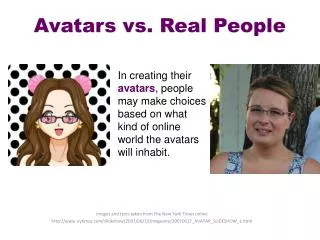
Relation to Self • Self portraits • Similarities to users • Self expression • Exploring new identities • Alter Ego Project
Real World Effects • Politics • Presence in virtual worlds • Voter behavior • Business • Virtual $ = Real $ • Presence in virtual worlds • Education • Research on teacher avatars • Behavior • Real life influenced by virtual life
Conclusion Questions?
Journals • Electronic Journal of Virtual Culture • Journal of Virtual Environments • Speed: Technology, Media, Society • M/C: A Journal of Media and Culture • Journal of Online Behavior • Journal of Computer-Mediated Communication Also, several education and/or psychology journals could be a possibility if I further develop the sections of this paper with an emphasis on these areas.Source: http://www.uiowa.edu/~commstud/resources/digitalmedia/digitalnews.html