Download
1 / 26
260 likes | 373 Vues
This guide explores Vitamin D's significance in maintaining health, focusing on newly arrived migrants and their unique needs. It highlights the consequences of Vitamin D deficiency, which affects many in Western Australia, particularly children and those with limited sun exposure. The document outlines dietary sources of Vitamin D, symptoms of deficiency, and recommended screening and treatment strategies. Funded by the Australian Government, this initiative emphasizes community support and the essential role of nutrition in the wellbeing of new arrivals.

E N D
Vitamin D Natalie Vicca Good Food for New Arrivals Project ASeTTS
ASeTTS • Association for Services to Torture and Trauma Survivors • Free & Confidential service • Counselling, advocacy, support, group and community activities
Good Food for New Arrivals • Funded by Australian Government under the Stronger Families and Communities Invest to Grow Program.
Services at ASeTTS www.asetts.org.au • Counselling & Advocacy • Community development programs and support groups • Personal Support Program • Volunteer program • Settlement grants program • Training, professional development & consultation • Strength to Strength Relationship support • Good Food for New Arrivals Nutrition Project • Integrated service centre MDT at selected Primaries • Newly Arrived Youth Support Service • Sessional psychiatrist
Australia’s Humanitarian Programme • Nationally 13,000 accepted each year 2006 • Total under 18 years = 56% • Under 9 years old = 27%
Learning Objectives • Be aware of sources and function of Vit D • Be aware of the effects of Vit D deficiency • Recognise groups at risk of deficiency • The situation in WA • Identify screening/treatment strategies
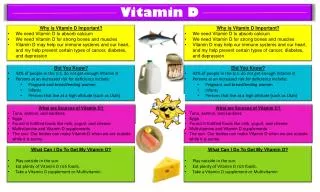
Sources • Sunlight -D3 cholecalciferol • Diet -D2 ergocalciferol • Fish, Eggs, Margarine, Milk, some meats • Requirements = 5-15 Micrograms/day (Nutrient Reference Values for Australia and New Zealand 2006)
Function • Variety of neuromuscular and physiological functions • Maintains serum calcium and phosphorus • Role in enhancing immune function
sunlight skin 7 -dehydrocholesterol cholecalciferol Vitamin D3 (fish, meat) Vitamin D2 (supplements) liver 25 dihydroxyvitamin D3 1,25-dihydroxyvitamin D3 ↑Ca absorption small intestine ↑Urinary calcium reabsorption (kidney) ↑Bone mineralisation kidney
Deficiency • Rickets in children • Osteoporosis and Osteomalacia adults • Implicated in development of • Psoriasis • Type 1 Diabetes Mellitus • Multiple Sclerosis • Gastrointestinal Cancers
WA Situation • Migrant Health found approx 16% of children and 11% of adults have moderate to severe vitamin D deficiency • Many more with mild deficiency - 40% • Have been emergency presentations due to hypocalcaemic seizures
Who is at risk? • Those who do not get enough sunlight. • Covered for cultural reasons • Dark skin needs longer exposure • Elderly • Breastfed babies of deficient mothers • Babies not introduced to solids appropriately
Sun exposure • Outside of peak hours • Without sun screen for short periods only • Hands, arms and face if possible • Darker skins require longer exposure • 7 minutes in summer for moderate to fair skin, up to 3-4 times longer for highly pigmented skins.
Symptoms and Signs • Young Infants • Restlessness • Poor sleep • Craniotabes (Soft posterior skull due to reduced mineralisation)
Older infants • Delayed sitting/crawling • Delayed closure fontanelle • Bossing of skull • Costochondral beading • Delayed tooth development Photos courtesy of Tom D Thacher, MD
Children (1-4 yrs) • Enlarged Epiphysial cartilages wrists/ankles • Kyphoscoliosis • Delayed walking • Abnormal teeth excessive caries
Bow leg abnormality Knock knees Photos courtesy of Tom D Thacher, MD
Older children and adolescents • Painful walking • Bowlegs • Knock knees • Abnormal teeth • Excessive caries • Neuromuscular hyperactivity muscle weakness
Adults • Weak bones • Bone pain (spinal, pelvic, legs) • Muscle weakness • Hypocalcaemia • Compressed vertebrae • Pelvic flattening • Easy fracturing
What can be done? • Screening • Blood test – vitamin D, U&E’S, PTH, Ca, LFT’s • Signs or symptoms screened by GP
Treatment • Children • Managed via PMH due to sole access to supplementation • Adults • Managed by GP • E.g. Ostelin 1000 3-5 tablets/d
After 2 years of treatment Photos courtesy of Tom D Thacher, MD
Summary • SPOT – those at risk • SCREEN - those likely to be deficient • SUPPLEMENT – those with low levels • Slip • Slap • Slop • Still stands but….