Digestive System
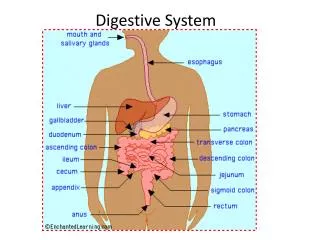
The digestive system is a complex network responsible for breaking down food and absorbing nutrients. It comprises the alimentary canal, which extends from the mouth to the anus, and several accessory organs including the pancreas, liver, and gallbladder. The process begins in the mouth with mechanical and chemical breakdown, continues through the esophagus to the stomach where gastric juices transform food into chyme, and concludes in the small and large intestines where absorption and waste elimination occur. This overview highlights the key organs and their functions in digestion and nutrient processing.

Digestive System
E N D
Presentation Transcript
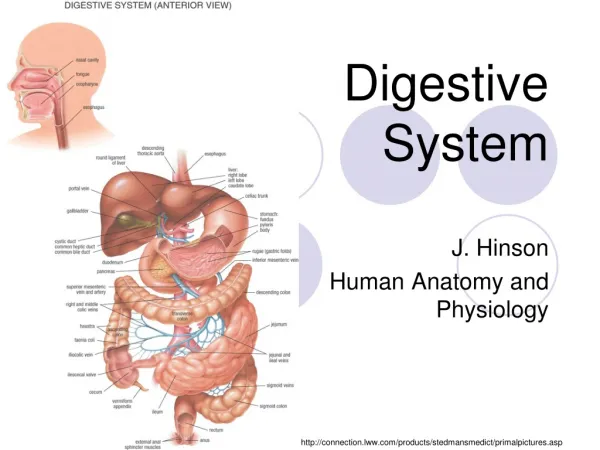
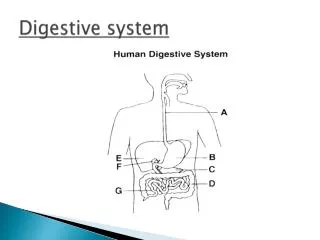
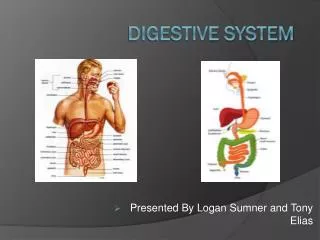
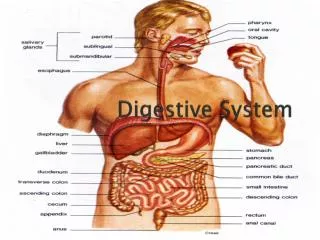
Function • The mechanical/chemical breakdown of foods and absorption of nutrients by cells • Alimentary canal (9m from mouth to anus) • Accessory organs- pancreas, liver, gall bladder
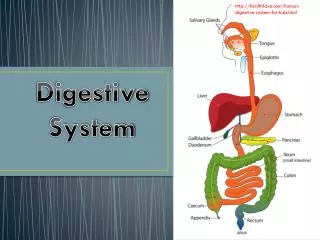
Alimentary Canal • mouth, pharynx, esophagus, stomach, sm intestine, lg intestine, anal canal • Movements of Tube: • Mixing movements- rhythmic contractions that mix food with digestive juices • Propelling movements- rings of muscles contract/relax to push food down canal (Peristalsis)
Mouth • Begins digesting by chewing/mixing food with saliva • Tongue- moves food • connect to floor of mouth by frenulum • taste buds
Palate- forms roof of oral cavity • Uvula at back of mouth • Palatine tonsils- back of mouth/throat • Organs protect against infection • Teeth- primary vs. secondary • Incisors, cuspids, bicuspids, premolars, molars • Used for chewing food
Salivary GLands • Serous cells produce amylase- breakdowns food • Mucous cells produce mucus- lubrication during swallowing • Parotid Glands • Submandibular Glands • Sublingual Glands
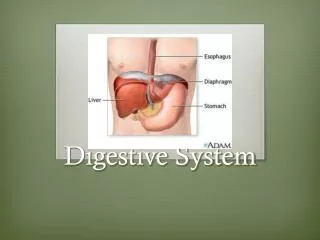
Pharynx/Esophagus • Pharynx- nasal and oral cavities • nasopharynx,oropharynx, laryngopharynx • Esophagus- moves to the stomach, penetrates the diaphragm at the esophageal hiatus • lower esophageal sphincter-prevent food and chemicals from moving up the stomach
Stomach • *J-shaped, pouch like organs that hangs inferior to the diaphragm • 1 liter capacity • Four main parts of the stomach • Cardiac -esophageal opening-cardiac sphincter • Fundic -temporary storage area, lies above the cardiac region • Body -central area of the stomach • Pyloric -pyloric sphincter, controls emptying of the stomach into the sm. Intestine
Lining of the stomach is a mucous membrane – with small openings called gastric pits, containing gastric glands • Gastric Juice- pepsin Chyme–broken down food molecules from gastric juices/movement of stomach • released from the pyloric sphincter valve into the first portion of the small intestine – duodenum
Pancrease • secretes pancreatic juicePancreatic juice – digests fats, breaks down nucleic acids into nucleotides
Liver • BILIARY SYSTEM – functions to create bile used in digestion; liver, gall bladder and ducts • LIVER- large right lobe and small left lobe • Hepatic portal vein – delivers blood to the liver
Functions • maintains normal concentration of blood glucose • breakdown of lipids and fats • protein metabolism (forming urea, synthesizing plasma proteins such as clotting factors,(converting amino acids); • stores iron and vitamins • destroys damaged red blood cells • removes toxic substances from the blood • secretes bile
Bile – yellowish-green liquid secreted from hepatic cells (when bile pigments build up in blood, skin turns green, a condition called jaundice). • Bile empties into the duodenum • Bile aids in digestion, bile salts break down fat globules into smaller droplets – emulsification
Small Intestine • tubular organ that extends from the pyloric sphincter, many loops and coils, fills much of the abdominal cavity • receives secretions from the pancreas and liver, completes digestion of nutrients and chyme, absorbs 1. Duodenum - first part of the small intestine2. Jejunum – second part, ~2.2 m3. Ilium – third part, longest ~3.3 m • *jejunum and ilium are continuous
Intestinal Villi – increase surface area for absorption • Function- secrete chemicals to break down food and carry away these nutrients in the blood (absorption)
Large Intestine • Cecum– beginning of the large intestine, pouchlike, closed end called the vermiform appendix (ileocecalvalve) • Colon – ascending / transverse / descending / sigmoid • Rectum – stores waste before it is expelled from the body • Anal canal - ends in the anus, muscular sphincter which controls the exit of waste
Functions – secretes mucus to protect the wall against abrasion - reabsorbs water and passes along material that was not digested - contains intestinal flora (bacteria to break down cellulose, also produce intestinal gas) • Mass movements – large portions of the colon contract to move material through it, 2-3 times a day usually after eating
Sum it up 1. Food 2. Mouth-teeth, tongue, amylase break down 3. Moves down Esophagus by Peristalsis 4. Enters stomach- chyme 5. Enters Sm. Intestine at Deudenum- liver/gall bladder secret bile – villi absorb nutrients jejunum ileum 6. Enters Lg. Intestine Cecum Colon Rectum Anus