Download
1 / 11
110 likes | 212 Vues
Explore the key skeletal muscle groups essential for movement in the head, neck, upper extremities, trunk, respiratory system, lower extremities, and lower leg. Understand functions such as flexion, extension, abduction, adduction, and rotation. Learn about specific muscles like the orbicularis oculi, pectoralis major, and gastrocnemius. Discover how movements like supination and pronation affect hand positions.

E N D
Skeletal Muscle Groups Movement
Head and Neck • Facial muscles • Orbicularis oculi= circular muscle around the eye • Orbicularis oris= circular muscle around the mouth • Zygomaticus=smiling muscles • Masseter=mastication • Temporal= mastication
Head and Neck • Sternocleidomastoid: flexes head • Trapezius: shrugs shoulders, extends head
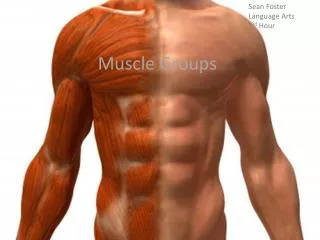
Upper Extremities • Pectoralis major: flexes upper arm (chest muscle) • Latissimus Dorsi: extends upper arm (on back) • Deltoid: abducts upper arm • Biceps Brachii: flexes forearm • Triceps Brachii: extends forearm
Trunk/Torso • Abdominals: • Rectus Abdominus (6pack) • External Oblique (R & L flank) • Internal Oblique • Transverse Abdominis
Respiratory Muscles • Intercostals (between each rib) • Diaphragm
Muscles that move lower extremities • Gluteus Maximus: extends thigh • Adductor Muscles: adducts thighs • Hamstring Muscles: • Semimeeembraneous • Semitendinosus Flexes Lower Leg • Biceps Femoris
Quadriceps femoris Extends lower leg: • Rectus femoris • Vastus Lateralis • Vastus intermedius • Vastus medialis
Muscles of lower leg • Tibialis anterior: dorsiflexes foot • Gastrocnemius: plantar flexes foot • Peroneus Group: flexes foot
Types of Movements • Flexion: decreases the angle between 2 bones at the joint.. (Bending0 • Extension: increases the angle between 2 bones at the joint…(straightening) • Abduction: movement away from the midline • Adduction: Movement toward the midline
Types of Movement Rotation: movement around a longitudinal axis Hand positions that results from rotation of the forearm. Supination Pronation