Although, if, because
This guide explores subordinate conjunctions, specifically "although," "if," and "because." It explains their functions in emphasizing contrasts, presenting conditions, and stating reasons within sentences. Examples illustrate their application, like using "although" to highlight unexpected outcomes or "because" to indicate causality. Clear sentence constructions demonstrate how these conjunctions link clauses effectively, along with essential comma rules. This resource is valuable for improving sentence complexity and coherence in writing.

Although, if, because
E N D
Presentation Transcript
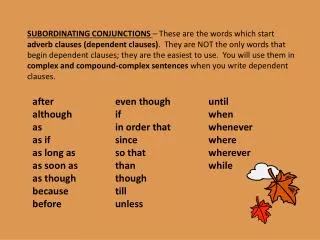
Some subordinate conjunctions: Although, if, because
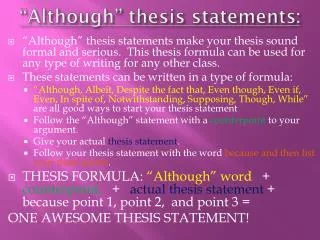
Although, if, because • Although is used to emphasize a contrast, a difference, or something unexpectedAlthough the symbol was well-known, it was not well-respected. • Ifis used to present a conditionIf a corporation wants to grow, it needs to know a lot about finance. • Because is used to present a reasonShe felt sick because she consumed 4 hot dogs, and 3 cups of soda.
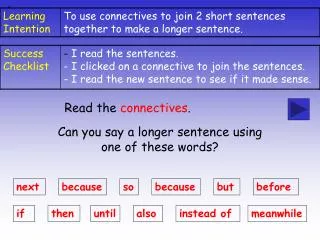
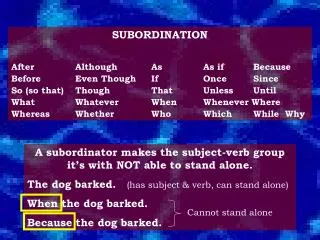
Sentence construction • Although, if, and because are subordinate conjunctions. They are used to join two clauses in one sentence. A clause is a group of words that has a subject and a verb. • A subordinate conjunction can come between the 2 clauses or at the beginning of the first clause.
Comma Rule • Clause subordinate conjunction clause.The symbol was not well-respected although it was well-known. • Subordinate conjunction clause, clause.Although the symbol was well-known, it was not well-respected. Because the company’s jeans became very popular, its revenue increased.
Complete these sentences: • If you equate your product with young people_________________________ • He converted his dollars to Euros because_______________________ • ______________________if you are a smart consumer.
Write more sentences • Write 6 sentences that each contain a subordinate conjunction. Try to use some vocabulary words from Inside Reading II.