Section 3.5
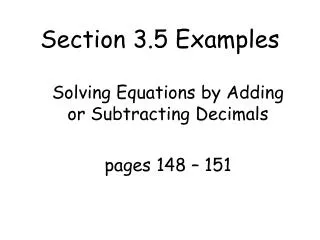
This section focuses on applying the Distributive Property to solve various equations effectively. Clear, step-by-step instructions guide learners through the process. Practice problems include equations like 3(x - 4) = 48 and 4x - 8(x + 1) = 8. Each problem illustrates how to distribute correctly and combine like terms, ultimately leading to isolated variables. Important insights on identifying valid solutions and understanding conditions for real numbers versus no solutions are also discussed. Perfect for students looking to strengthen their algebra skills.


Section 3.5
E N D
Presentation Transcript
Distributive Property You must use the Distributive Property first. Then use the rules from Section 3.4 to solve.
3.5 Using the Distributive Property Key Skills Solve the equation: 3(x – 4) = 48 4(x + 1) = 16 3x – 12 = 48 4x + 4 = 16 3x – 12+ 12 = 48 + 12 4x + 4– 4 = 16 – 4 3x = 60 4x = 12 3 3 4 4 x = 20 x = 3
3.5 Using the Distributive Property Key Skills Solve the equation: 3y – 8 – y = 6 2(x + 5) = –16 2y – 8 = 6 2x + 10 = –16 2y – 8+ 8 = 6 + 8 2x + 10– 10 = –16 – 10 2y = 14 2x = –26 2 2 2 2 y = 7 x = –13
3.5 Using the Distributive Property Solve the equation: 4x – 8(x + 1) = 8 4t + 7 – t = 19 4x – 8x – 8 = 8 3t + 7 = 19 –4x – 8 = 8 3t + 7– 7 = 19 – 7 –4x – 8 + 8 = 8 + 8 3t = 12 –4x = 16 3 3 –4 –4 t = 4 x = –4
3.5 Using the Distributive Property Solve the equation, is the answer a solution? 2(x + 4) – 5 = 2x + 3 If all variables cancel, you must look at what’s left. 2x + 8 – 5 = 2x + 3 2x + 3 = 2x + 3 If what’s left is true, answer is all real numbers. 2x + 3 – 2x = 2x + 3 – 2x 3 = 3 If what’s left is not true, answer is no solution. Does this make sense?
3.5 Using the Distributive Property Solve the equation, is the answer a solution? 8x – 2(3x – 4) = 5x – 7. 8x + (–6x) + (8) = 5x – 7 2x + 8 = 5x – 7 2x + 8 – 2x = 5x – 7 – 2x 15 = 3x 8 = 3x – 7 3 3 5= x 7 + 8 = 3x – 7 + 7
-10 -10 3.5 Using the Distributive Property 4x – 3(2x + 4) = 8x – 25 4x – 6x – 12 = 8x– 25 –2x – 12 = 8x – 25 –2x = 8x – 25 + 12 –2x = 8x – 13 –2x – 8x = 8x – 13 – 8x –10x = –13 x = 1.3
-8 -8 3.5 Using the Distributive Property 4x – 7(x + 6) = 5x – 2 4x – 7x – 42 = 5x– 2 –3x – 42 = 5x – 2 –3x = 5x – 2 + 42 –3x = 5x + 40 –3x – 5x = 5x – 5x + 40 –8x = 40 x = –5
8 8 3.5 Using the Distributive Property 5x – 2(3x + 7) = 7x + 12 5x – 6x – 14 = 7x + 12 –x – 14 = 7x + 12 –x – 14 – 12 = 7x + 12 – 12 –x – 26 = 7x –x + x – 26 = 7x + x –26 = 8x –3.25 = x
Assignment Section 3.5 Page 145 # 12 – 45 (every 3rd)