Understanding DNA and RNA: Key Concepts and Transformations
530 likes | 650 Vues
This chapter delves into the fundamental concepts of DNA and RNA, exploring key experiments that shaped our understanding of genetics. Key topics include the structure of nucleotides, genetic transformation in bacteria, and the processes of transcription and translation. Through a series of questions and answers, we examine crucial scientific contributions from researchers like Griffith, Avery, and Hershey and Chase. This resource aids in grasping the molecular basis of heredity and the essential roles that DNA and RNA play in cellular functions.


Understanding DNA and RNA: Key Concepts and Transformations
E N D
Presentation Transcript
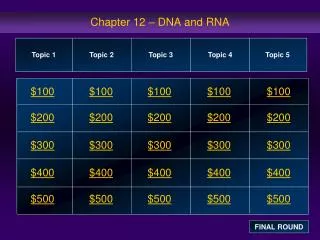
Chapter 12 – DNA and RNA Topic 1 Topic 2 Topic 3 Topic 4 Topic 5 $100 $100 $100 $100 $100 $200 $200 $200 $200 $200 $300 $300 $300 $300 $300 $400 $400 $400 $400 $400 $500 $500 $500 $500 $500 FINAL ROUND
Topic 1:$100 Question • Question: Which of the following is a nucleotide found in DNA? • a. ribose + thymine + phosphate group • b. deoxyribose + phosphate group + uracil • c. deoxyribose + phosphate group + cytosine • d. deoxyribose + uracil + phosphate group ANSWER BACK TO GAME
Topic 1:$100 Answer • Question: Which of the following is a nucleotide found in DNA? • a. ribose + thymine + phosphate group • b. deoxyribose + phosphate group + uracil • c. deoxyribose + phosphate group + cytosine • d. deoxyribose + uracil + phosphate group BACK TO GAME
Topic 1:$200 Question • Question: Avery’s experiments showed that bacteria are transformed by • a. proteins. • b. RNA. • c. DNA. • d. carbohydrates. ANSWER BACK TO GAME
Topic 1:$200 Answer • Question: Avery’s experiments showed that bacteria are transformed by • a. proteins. • b. RNA. • c. DNA. • d. carbohydrates. BACK TO GAME
Topic 1:$300 Question • Question: What did Griffith observe when he injected a mixture of heat-killed, disease-causing bacteria and live harmless bacteria into mice? • a. The mice were unaffected. • b. The harmless bacteria died. • c. The disease-causing bacteria changed into harmless bacteria. • d. The mice developed pneumonia. ANSWER BACK TO GAME
Topic 1:$300 Answer • Question: What did Griffith observe when he injected a mixture of heat-killed, disease-causing bacteria and live harmless bacteria into mice? • a. The mice were unaffected. • b. The harmless bacteria died. • c. The disease-causing bacteria changed into harmless bacteria. • d. The mice developed pneumonia. BACK TO GAME
Topic 1:$400 Question • Question: What would Hershey and Chase have concluded if both radioactive 32P and 35S were found in the bacteria in their experiment? • a. The virus’s protein coat was not injected into the bacteria. • b. The virus’s DNA was not injected into the bacteria. • c. Genes are made of protein. • d. Both the virus’s protein coat and its DNA were injected into the bacteria. ANSWER BACK TO GAME
Topic 1:$400 Answer • Question: What would Hershey and Chase have concluded if both radioactive 32P and 35S were found in the bacteria in their experiment? • a. The virus’s protein coat was not injected into the bacteria. • b. The virus’s DNA was not injected into the bacteria. • c. Genes are made of protein. • d. Both the virus’s protein coat and its DNA were injected into the bacteria. BACK TO GAME
Topic 1:$500 Question • Question: Because of base pairing in DNA, the percentage of • a. adenine molecules in DNA is about equal to the percentage of purines. • b. pyrimidines in DNA is about equal to the percentage of purines. • c. purines in DNA is much greater than the percentage of pyrimidines. • d. cytosine molecules in DNA is much greater than the percentage of guanine molecules. ANSWER BACK TO GAME
Topic 1:$500 Answer • Question: Because of base pairing in DNA, the percentage of • a. adenine molecules in DNA is about equal to the percentage of purines. • b. pyrimidines in DNA is about equal to the percentage of purines. • c. purines in DNA is much greater than the percentage of pyrimidines. • d. cytosine molecules in DNA is much greater than the percentage of guanine molecules. BACK TO GAME
Topic 2:$100 Question • Question: During transcription, an RNA molecule is formed • a. that is complementary to both strands of DNA. • b. that is identical to part of a single strand of DNA. • c. inside the nucleus. • d. that is double-stranded. ANSWER BACK TO GAME
Topic 2:$100 Answer • Question: During transcription, an RNA molecule is formed • a. that is complementary to both strands of DNA. • b. that is identical to part of a single strand of DNA. • c. inside the nucleus. • d. that is double-stranded. BACK TO GAME
Topic 2:$200 Question • Question: What is produced during transcription? • a. RNA molecules • b. RNA polymerase • c. DNA molecules • d. proteins ANSWER BACK TO GAME
Topic 2:$200 Answer • Question: What is produced during transcription? • a. RNA molecules • b. RNA polymerase • c. DNA molecules • d. proteins BACK TO GAME
Topic 2:$300 Question • Question: How many main types of RNA are there? • a. 1 • b. 2 • c. 3 • d. 4 ANSWER BACK TO GAME
Topic 2:$300 Answer • Question: How many main types of RNA are there? • a. 1 • b. 2 • c. 3 • d. 4 BACK TO GAME
Topic 2:$400 Question • Question: Which of the following are found in both DNA and RNA? • a. phosphate groups, guanine, and thymine • b. phosphate groups, guanine, and cytosine • c. phosphate groups, deoxyribose, and guanine • d. phosphate groups, ribose, and adenine ANSWER BACK TO GAME
Topic 2:$400 Answer • Question: Which of the following are found in both DNA and RNA? • a. phosphate groups, guanine, and thymine • b. phosphate groups, guanine, and cytosine • c. phosphate groups, deoxyribose, and guanine • d. phosphate groups, ribose, and adenine BACK TO GAME
Topic 2:$500 Question • Question: Unlike DNA, RNA contains • a. adenine. • b. phosphate groups. • c. uracil. • d. lactose. ANSWER BACK TO GAME
Topic 2:$500 Answer • Question: Unlike DNA, RNA contains • a. adenine. • b. phosphate groups. • c. uracil. • d. lactose. BACK TO GAME
Topic 3:$100 Question • Question: RNA contains the sugar • a. ribose. • b. deoxyribose. • c. glucose. • d. lactose. ANSWER BACK TO GAME
Topic 3:$100 Answer • Question: RNA contains the sugar • a. ribose. • b. deoxyribose. • c. glucose. • d. lactose. BACK TO GAME
Topic 3:$200 Question • Question: During DNA replication, a DNA strand that has the bases CTAGGT produces a strand with the bases • a. TCGAAC. • b. AGCTTG. • c. GATCCA. • d. GAUCCA. ANSWER BACK TO GAME
Topic 3:$200 Answer • Question: During DNA replication, a DNA strand that has the bases CTAGGT produces a strand with the bases • a. TCGAAC. • b. AGCTTG. • c. GATCCA. • d. GAUCCA. BACK TO GAME
Topic 3:$300 Question • Question: In eukaryotes, DNA • a. is located in the nucleus. • b. is located in the ribosomes. • c. is circular. • d. floats freely in the cytoplasm. ANSWER BACK TO GAME
Topic 3:$300 Answer • Question: In eukaryotes, DNA • a. is located in the nucleus. • b. is located in the ribosomes. • c. is circular. • d. floats freely in the cytoplasm. BACK TO GAME
Topic 3:$400 Question • Question: DNA is copied during a process called • a. replication. • b. transcription. • c. transformation. • d. translation. ANSWER BACK TO GAME
Topic 3:$400 Answer • Question: DNA is copied during a process called • a. replication. • b. transcription. • c. transformation. • d. translation. BACK TO GAME
Topic 3:$500 Question • Question: DNA replication results in two DNA molecules, • a. each with one new strand and one original strand. • b. one with two new strands and the other with two original strands. • c. each with two original strands. • d. each with two new strands. ANSWER BACK TO GAME
Topic 3:$500 Answer • Question: DNA replication results in two DNA molecules, • a. each with one new strand and one original strand. • b. one with two new strands and the other with two original strands. • c. each with two original strands. • d. each with two new strands. BACK TO GAME
Topic 4:$100 Question • Question: A promoter is a • a. binding site for DNA polymerase. • b. binding site for RNA polymerase. • c. start signal for transcription. • d. stop signal for transcription. ANSWER BACK TO GAME
Topic 4:$100 Answer • Question: A promoter is a • a. binding site for DNA polymerase. • b. binding site for RNA polymerase. • c. start signal for transcription. • d. stop signal for transcription. BACK TO GAME
Topic 4:$200 Question • Question: A mutation that involves one or a few nucleotides is called a(an) • a. inversion. • b. translocation. • c. point mutation. • d. chromosomal mutation. ANSWER BACK TO GAME
Topic 4:$200 Answer • Question: A mutation that involves one or a few nucleotides is called a(an) • a. inversion. • b. translocation. • c. point mutation. • d. chromosomal mutation. BACK TO GAME
Topic 4:$300 Question • Question: Genes contain instructions for assembling • a. purines. • b. proteins. • c. nucleosomes. • d. pyrimidines. ANSWER BACK TO GAME
Topic 4:$300 Answer • Question: Genes contain instructions for assembling • a. purines. • b. proteins. • c. nucleosomes. • d. pyrimidines. BACK TO GAME
Topic 4:$400 Question • Question: Which type of RNA functions as a blueprint of the genetic code? • a. tRNA • b. rRNA • c. mRNA • d. RNA polymerase ANSWER BACK TO GAME
Topic 4:$400 Answer • Question: Which type of RNA functions as a blueprint of the genetic code? • a. tRNA • b. rRNA • c. mRNA • d. RNA polymerase BACK TO GAME
Topic 4:$500 Question • Question: Why is it possible for an amino acid to be specified by more than one kind of codon? • a. Some codons have the same sequence of nucleotides. • b. There are 64 different kinds of codons but only 20 amino acids. • c. Some of the codons do not specify an amino acid. • d. The codon AUG codes for the amino acid methionine and serves as the “start” codon for protein synthesis. ANSWER BACK TO GAME
Topic 4:$500 Answer • Question: Why is it possible for an amino acid to be specified by more than one kind of codon? • a. Some codons have the same sequence of nucleotides. • b. There are 64 different kinds of codons but only 20 amino acids. • c. Some of the codons do not specify an amino acid. • d. The codon AUG codes for the amino acid methionine and serves as the “start” codon for protein synthesis. BACK TO GAME
Topic 5:$100 Question • Question: How many bases are needed to specify three amino acids? • a. 3 • b. 6 • c. 9 • d. 12 ANSWER BACK TO GAME
Topic 5:$100 Answer • Question: How many bases are needed to specify three amino acids? • a. 3 • b. 6 • c. 9 • d. 12 BACK TO GAME
Topic 5:$200 Question • Question: What does this figure show? • a. the order in which amino acids are linked • b. the code for splicing mRNA • c. the genetic code • d. anticodons ANSWER BACK TO GAME
Topic 5:$200 Answer • Question: What does this figure show? • a. the order in which amino acids are linked • b. the code for splicing mRNA • c. the genetic code • d. anticodons BACK TO GAME
Topic 5:$300 Question • Question: In E. coli, the lac operon controls the • a. breakdown of lactose. • b. production of lactose. • c. breakdown of glucose. • d. production of glucose. ANSWER BACK TO GAME
Topic 5:$300 Answer • Question: In E. coli, the lac operon controls the • a. breakdown of lactose. • b. production of lactose. • c. breakdown of glucose. • d. production of glucose. BACK TO GAME
Topic 5:$400 Question • Question: Hox genes • a. are not found in humans. • b. determine the location of an elephant’s tail. • c. are found in bacteria. • d. are regulated by operons. ANSWER BACK TO GAME
Topic 5:$400 Answer • Question: Hox genes • a. are not found in humans. • b. determine the location of an elephant’s tail. • c. are found in bacteria. • d. are regulated by operons. BACK TO GAME
Topic 5:$500 Question • Question: The figure here shows a(an) • a. DNA molecule. • b. amino acid. • c. protein. • d. RNA molecule. ANSWER BACK TO GAME