Understanding Covalent Bonding: A Quick Review of Key Concepts and Structures
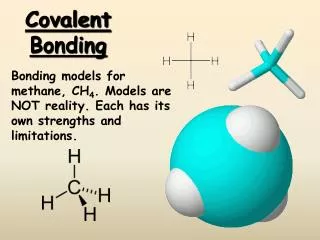
This quick review provides an overview of covalent bonding, emphasizing the sharing of electrons between nonmetals. Key concepts such as the octet rule, valence electrons, and different types of molecules (diatomic, molecular formulas) are explained. Additionally, this guide covers single, double, and triple bonds, along with guidelines for drawing Lewis structures. Examples include molecular structures for common compounds like water (H2O), ammonia (NH3), and carbon dioxide (CO2). Enhance your grasp of chemical bonding with clear illustrations and definitions.


Understanding Covalent Bonding: A Quick Review of Key Concepts and Structures
E N D
Presentation Transcript
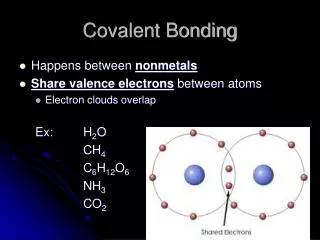
Quick Review • Covalent bond – two atoms held together by sharing electrons -- Usually occurs between nonmetals. • Octet Rule – chemical compounds tend to form so that each atom, by gaining, losing, or sharing electrons, has an octet of electrons in its highest energy level. • Valence electrons – the electrons in an atom’s outer energy level
Electron-dot diagrams • shows an atom’s valence electrons • Draw electron-dot diagrams for: N F Na O
New Terms • Molecule – a neutral group of atoms held together by covalent bonds • Molecular formula – shows the types and numbers of atoms combined in a single molecule (ex: H2O, CO2, H2SO4) • Diatomic molecule – molecule containing two atoms (Examples: H2, N2, O2, F2, Cl2, Br2, I2, HCl, NO)
· · · · Using Electron Dot Notation diagrams H2 molecule (nonpolar covalent = EQUAL sharing) • H· ·H H : H • Structural formula: H-H (Use single line for e- pair) the hydrogen orbitals overlap
F2 molecule ·· ·· ·· ·· : F· ·F :: F : F : ·· ·· ·· ·· • Structural formula: F-F • Each fluorine atom has 8 electrons in the outer energy level.
HCl molecule • H Cl H Cl • H – Cl • Each atom now has a filled outer energy level.
Usually there will be more than two atoms bonding together. • Water H2O • Each hydrogen atom is bonded to oxygen atom H O H O H H • Structural formula H O H
Try these molecules: NH3, ClI, H2O2 • NH3 molecule • Each hydrogen atom is bonded to the nitrogen atom. H N H H
ClI molecule (chlorine and iodine) Cl I Cl I Structural formula Cl – I
H2O2 molecule • H O H O O H O H Structural Formula H O O H
Bond Length and Energy • Bond length – the average distance between bonded atoms • Bond energy – energy required to break a chemical bond and form neutral isolated atoms.
Single Bonds • Single bonds – a covalent bond produced by the sharing of one pair of electrons between two atoms. • All of the examples so far have been of single bonds.
Double Bonds • Double bonds – a covalent bond produced by the sharing of two pairs of electrons between two atoms. • O2 molecule O O Structural formula O=O
Triple Bonds • Triple bonds – a covalent bond produced by the sharing of three pairs of electrons between two atoms. • N2 molecule N N Structural formula N≡N
Relationships • Between bond length and # of bonds: As the number of bonds INCREASES, the bond length DECREASES • Between bond energy and # of bonds: As the number of bonds INCREASES, the energy required to break those bonds INCREASES
How to draw Lewis Structures (AKA electron dot diagrams) Two Types of Electron Pairs: • Shared Pair – a bonded pair; exists between 2 atoms in the same molecule. Represented by a straight line between the bonded atoms. • Unshared Pair – a lone pair; belongs entirely to one atom. Represented by a pair of dots on that atom.
Rules for Drawing Lewis Structures: • 1) Draw a skeleton structure for the compound by joining the atoms with single bonds (single straight lines). • The central atom is usually: • a) The one with the highest number of valence electrons • b) The largest atom • c) The least electronegative atom
Rules for Drawing Lewis Structures: • d) Hydrogen will NEVER be a central atom • e) Oxygen will only be central if bonded to H or F
Rules for Drawing Lewis Structures: • 2) Count/Tally the number of total valence electrons • 3) Determine the number of electron pairs by dividing the total number of valence electrons (step #2) by 2 • 4) Determine the number of available electron pairs by subtracting the number of pairs already used in the skeleton structure
Rules for Drawing Lewis Structures: • 5) Place LONE PAIRS around the terminal/end atoms. If any pairs are left, put them as lone pairs on the central atom • 6) Check the OCTET RULE. If the central atom is not yet surrounded by 8 electrons, form multiple bonds.
Rules for Drawing Lewis Structures: • Example: draw the Lewis Structure for Carbon Dioxide
Rules for Drawing Lewis Structures: • Draw the Lewis Structure for Methanal (Formaldehyde) CH2O
Rules for Drawing Lewis Structures: • CF4PCl3 • OCl2O2