The Scientific Revolution
90 likes | 196 Vues
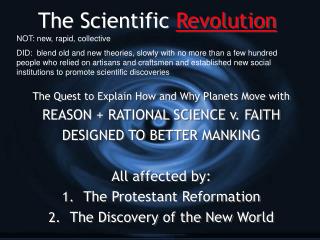
The Scientific Revolution marked a pivotal shift in scientific thought from ancient Greek philosophy to modern science. Beginning with Aristotle's inductive reasoning but limited by the lack of tools, the Renaissance sparked a revival of deductive reasoning, emphasizing logic, experiments, and observation. Key figures like Copernicus reshaped our understanding of the cosmos, while Galileo challenged existing paradigms using the telescope, despite facing opposition. Isaac Newton's "Principia" laid the foundation for physics and calculus, influencing thinkers like Einstein. This era's advancements continue to impact various fields, including politics and philosophy.


The Scientific Revolution
E N D
Presentation Transcript
History of Science • Ancient Greeks • Aristotle • Inductive Reasoning • Lacked tools (strictly Thought Experiments)
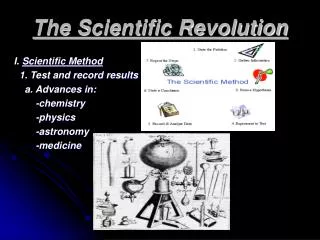
New Methods of Science • Advancements in various areas of science • Brining back Inductive Reasoning • Renaissance used Deductive Reasoning • Logic, experiments, observation became important • Tools, books, all help advance scientific knowledge
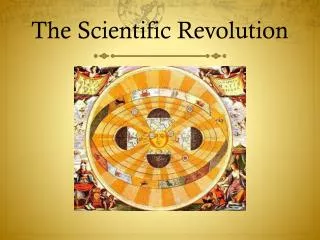
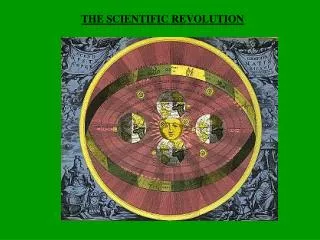
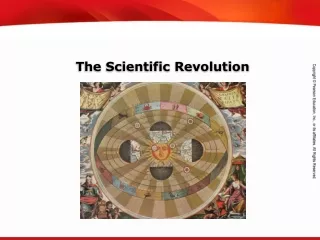
Copernicus • De Revolutionibus orbium coelestium • Doctor, Lawyer, Military Strategist, and astrologer • Three major theses • Credit due to Muslim and Greek thinkers
Galileo • Take ideas of his predecessors and prove them • Telescope • Observe • Met with opposition in Rome • Renounce claims • Under house arrest • Pope John Paul II apologizes
Sir. Isaac Newton • Principia • Laws of motion and gravity • Basis for physics and calculus • Einstein would disprove a number of Newtonian beliefs
Legacy and Importance • Inspired later thinkers • Thomas Edison • Process of performing science • Same process applied to other areas • Politics, Philosophy, and history