Mass Extinctions
This text delves into the significant mass extinctions throughout geological history, identifying potential triggers such as asteroid impacts, large basalt outflows, and carbon dioxide fluctuations, which affect atmospheric and oceanic chemistry. It discusses the cyclical nature of extinction events approximately every 20-30 million years and the implications of these events on biodiversity and evolution. Highlighting the concept of impact-induced extinctions, particularly the KT event, this analysis emphasizes how such catastrophic events reset the evolutionary clock, enabling rapid recovery and diversification of life.

Mass Extinctions
E N D
Presentation Transcript
Mass Extinctions Evidence for Many Events over Geological History
Potential Triggers • Asteroid Impacts = sudden
Large Basalt Outflows • Large CO2 changes which can affect atmospheric and ocean chemistry (slow)
Periodic Comet Strikes • Fossil record shows some 26-27 million year period of some extinction event (usually small) • Nemesis Theory (likely not correct) • On the time scale of 20-30 million years (1/10 of our galactic orbit) – nearby stars could perturb our Oort cloud of Comets
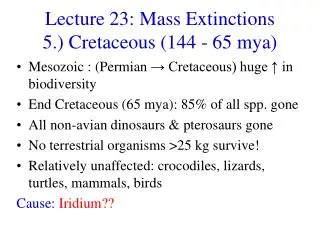
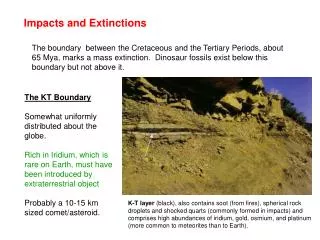
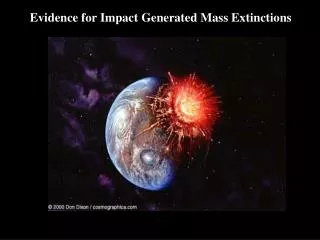
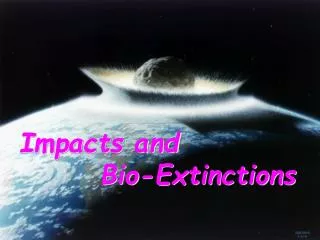
At least a dozen events The concept of impact induced extinction events is relatively new – first evidence came in 1980 regarding the KT event (65 million years ago – dead dinosaurs). Further research and data have no shown that such events are common.
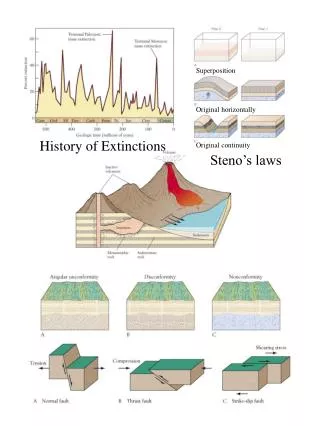
Periodic Extinctions of Varying Amplitude (percent extincted)
Mass Extinctions and Evolution • ½ to 2/3 of all species are eliminated during big events • Plankton in the ocean is nuked • So both the land and water are effected • Encephelization Levels (EL) in organisms measure the amount of brain tissue in excess of that needed for basic metabolism maintenance
Evolution of Intelligence? • This diagram has many features: EL Doubling time About 2 MY Unaltered EL Evolution would have produced “humans” 60 MYA Last 200 million years has constant slope Fastest Growth: 600-250 MYA; beginning of sea to land migration
Implications • Evolutionary Clock gets reset • Life recovers (relatively rapidly) to fill new ecological niches this empowers species diversification • This means that “survival of the fittest” doesn’t work on long timescales random catastrophe important • Strangely, nature confirms that a “new world will arrive out of the ashes of the old one” • This will happen again (right after the final)