Analysis of 100GHz Antenna Arrays for Optimal Performance and Far-Field Characteristics
This study explores the design and performance characteristics of 100GHz antenna arrays, focusing on the orientations and wiring configurations of array elements. We analyze the far-field radiation patterns for different angles, including configurations using horn and lens antennas. Key parameters such as gain, effective aperture area, and losses due to ohmic resistance, air/dielectric interfaces, and back radiation are evaluated. Results indicate significant performance metrics, paving the way for advancements in high-frequency antenna technologies.

Analysis of 100GHz Antenna Arrays for Optimal Performance and Far-Field Characteristics
E N D
Presentation Transcript
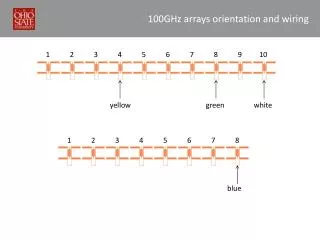
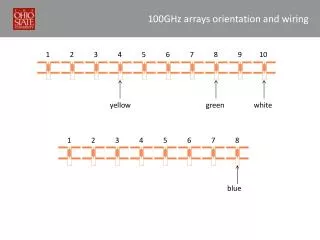
100GHz arrays orientation and wiring 1 2 3 4 5 6 7 8 9 10 yellow green white 1 2 3 4 5 6 7 8 blue
100GHz array far field center of array 1 2 3 4 5 6 7 8 9 10 angle 47.5o 6o 6o 47.5o 38o 28.5o 17.5o 28.5o 17.5o 38o Far field pattern of the 5 (left) array elements
100GHz antennas’ characteristics • Horn antenna • (diameter=2cm (dm), length= 5.5cm (L)) Gain = 295 = 24.27 (dB) Aeff = 211.3mm2 => D = 8.2mm • Lens antenna Gain = 335.7 = 25.27 (dB) Aeff = 240.5mm2=> D = 8.75mm Including losses: Ohmic:10%, Air/dielectric interface:30% , Back (air) radiation: 9%