
Understanding and Calculating Binomial Probabilities
This guide covers the binomial probability formula and how to calculate binomial probabilities using examples. The binomial probability formula is represented as nCxp^xq^(n-x), where n is the number of trials, x is the number of successes, p is the probability of success in one trial, and q is the probability of failure. It includes step-by-step examples, such as calculating the probability of certain numbers of households owning gas grills, using toppings on hot dogs, or small businesses having websites. Utilize the binomial probability calculator for efficient calculations.

Understanding and Calculating Binomial Probabilities
E N D
Presentation Transcript
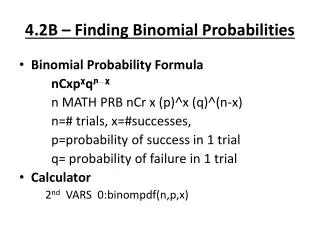
4.2B – Finding Binomial Probabilities • Binomial Probability Formula nCxpᵡqᶮ ᵡ n MATH PRB nCr x(p)˄x (q)˄(n-x) n=# trials, x=#successes, p=probability of success in 1 trial q= probability of failure in 1 trial • Calculator 2nd VARS 0:binompdf(n,p,x)
Probability Distribution • List of possible values of x with each corresponding probability in a table. • Example: 7 participants (#trials) 36% answered yes (p=.36) (q=.64) Binomial probability distribution for # responding yes. P(0) = ₇C₀(.36)⁰(.64)⁷≈.044 = binompdf(7,.36,0) P(1) = ₇C₁(.36)(.64)⁶≈.173 = binompdf(7,.36,1) P(2) = ₇C₂(.36)²(.64)⁵≈.292 = binompdf(7,.36,2) etc. x 0 1 2 3 4 5 6 7 p(x) .044 .173 .292 .274 .154 .052 .010 .001
Examples: • 1. 58% own gas grills. Select 100 households. What is probability exactly 65 will own one? • 2. 71% use more than 1 topping on hot dog. Select 250 people. What is probability exactly 178 use more than 1 topping? • 3. 75% of small businesses have website. If 10 are selected what is probability exactly 4 have a web site?
Examples: • 1. 58% own gas grills. Select 100 households. What is probability exactly 65 will own one? ₁₀₀C₆₅(.58)⁶⁵(.42)ᶟ⁵ = • 2. 71% use more than 1 topping on hot dog. Select 250 people. What is probability exactly 178 use more than 1 topping? • 3. 75% of small businesses have website. If 10 are selected what is probability exactly 4 have a web site?
Examples: • 1. 58% own gas grills. Select 100 households. What is probability exactly 65 will own one? ₁₀₀C₆₅(.58)⁶⁵(.42)ᶟ⁵ = binompdf(100,.58,65) • 2. 71% use more than 1 topping on hot dog. Select 250 people. What is probability exactly 178 use more than 1 topping? • 3. 75% of small businesses have website. If 10 are selected what is probability exactly 4 have a web site?
Examples: • 1. 58% own gas grills. Select 100 households. What is probability exactly 65 will own one? ₁₀₀C₆₅(.58)⁶⁵(.42)ᶟ⁵ = binompdf(100,.58,65) ≈.03 • 2. 71% use more than 1 topping on hot dog. Select 250 people. What is probability exactly 178 use more than 1 topping? • 3. 75% of small businesses have website. If 10 are selected what is probability exactly 4 have a web site?
Examples: • 1. 58% own gas grills. Select 100 households. What is probability exactly 65 will own one? ₁₀₀C₆₅(.58)⁶⁵(.42)ᶟ⁵ = binompdf(100,.58,65) ≈.03 • 2. 71% use more than 1 topping on hot dog. Select 250 people. What is probability exactly 178 use more than 1 topping? ₂₅₀C₁₇₈(.71)˄178(.29)˄72 = • 3. 75% of small businesses have website. If 10 are selected what is probability exactly 4 have a web site?
Examples: • 1. 58% own gas grills. Select 100 households. What is probability exactly 65 will own one? ₁₀₀C₆₅(.58)⁶⁵(.42)ᶟ⁵ = binompdf(100,.58,65) ≈.03 • 2. 71% use more than 1 topping on hot dog. Select 250 people. What is probability exactly 178 use more than 1 topping? ₂₅₀C₁₇₈(.71)˄178(.29)˄72 = binompdf(250,.71,178) • 3. 75% of small businesses have website. If 10 are selected what is probability exactly 4 have a web site?
Examples: • 1. 58% own gas grills. Select 100 households. What is probability exactly 65 will own one? ₁₀₀C₆₅(.58)⁶⁵(.42)ᶟ⁵ = binompdf(100,.58,65) ≈.03 • 2. 71% use more than 1 topping on hot dog. Select 250 people. What is probability exactly 178 use more than 1 topping? ₂₅₀C₁₇₈(.71)˄178(.29)˄72 = binompdf(250,.71,178)≈.056 • 3. 75% of small businesses have website. If 10 are selected what is probability exactly 4 have a web site?
Examples: • 1. 58% own gas grills. Select 100 households. What is probability exactly 65 will own one? ₁₀₀C₆₅(.58)⁶⁵(.42)ᶟ⁵ = binompdf(100,.58,65) ≈.03 • 2. 71% use more than 1 topping on hot dog. Select 250 people. What is probability exactly 178 use more than 1 topping? ₂₅₀C₁₇₈(.71)˄178(.29)˄72 = binompdf(250,.71,178)≈.056 • 3. 75% of small businesses have website. If 10 are selected what is probability exactly 4 have a web site? ₁₀C₄(.75)⁴(.25)⁶
Examples: • 1. 58% own gas grills. Select 100 households. What is probability exactly 65 will own one? ₁₀₀C₆₅(.58)⁶⁵(.42)ᶟ⁵ = binompdf(100,.58,65) ≈.03 • 2. 71% use more than 1 topping on hot dog. Select 250 people. What is probability exactly 178 use more than 1 topping? ₂₅₀C₁₇₈(.71)˄178(.29)˄72 = binompdf(250,.71,178)≈.056 • 3. 75% of small businesses have website. If 10 are selected what is probability exactly 4 have a web site? ₁₀C₄(.75)⁴(.25)⁶ = binompdf(10,.75,4)
Examples: • 1. 58% own gas grills. Select 100 households. What is probability exactly 65 will own one? ₁₀₀C₆₅(.58)⁶⁵(.42)ᶟ⁵ = binompdf(100,.58,65) ≈.03 • 2. 71% use more than 1 topping on hot dog. Select 250 people. What is probability exactly 178 use more than 1 topping? ₂₅₀C₁₇₈(.71)˄178(.29)˄72 = binompdf(250,.71,178)≈.056 • 3. 75% of small businesses have website. If 10 are selected what is probability exactly 4 have a web site? ₁₀C₄(.75)⁴(.25)⁶ = binompdf(10,.75,4) ≈ .016
Examples • 41% of women choose reading as favorite leisure activity. 4 are selected What is the probability that they answer yes it is their favorite? • 1) exactly 2 respond yes. P(2) = binompdf(4,.41,2) • 2) at least 2 respond yes • 3) Fewer than 2 respond yes.
Examples • 41% of women choose reading as favorite leisure activity. 4 are selected What is the probability that they answer yes it is their favorite? • 1) exactly 2 respond yes. P(2) = binompdf(4,.41,2) = ₄C₂(.41)²(.59)² • 2) at least 2 respond yes • 3) Fewer than 2 respond yes.
Examples • 41% of women choose reading as favorite leisure activity. 4 are selected What is the probability that they answer yes it is their favorite? • 1) exactly 2 respond yes. P(2) = binompdf(4,.41,2) = ₄C₂(.41)²(.59)²≈.351 • 2) at least 2 respond yes • 3) Fewer than 2 respond yes.
Examples • 41% of women choose reading as favorite leisure activity. 4 are selected What is the probability that they answer yes it is their favorite? • 1) exactly 2 respond yes. P(2) = binompdf(4,.41,2) = ₄C₂(.41)²(.59)²≈.351 • 2) at least 2 respond yes = P(2) + P(3) + P(4) • 3) Fewer than 2 respond yes.
Examples • 41% of women choose reading as favorite leisure activity. 4 are selected What is the probability that they answer yes it is their favorite? • 1) exactly 2 respond yes. P(2) = binompdf(4,.41,2) = ₄C₂(.41)²(.59)²≈.351 • 2) at least 2 respond yes = P(2) + P(3) + P(4) P(2)=.351 P(3) = • 3) Fewer than 2 respond yes.
Examples • 41% of women choose reading as favorite leisure activity. 4 are selected What is the probability that they answer yes it is their favorite? • 1) exactly 2 respond yes. P(2) = binompdf(4,.41,2) = ₄C₂(.41)²(.59)²≈.351 • 2) at least 2 respond yes = P(2) + P(3) + P(4) P(2)=.351 P(3) = binompdf(4,.41,3) = • 3) Fewer than 2 respond yes.
Examples • 41% of women choose reading as favorite leisure activity. 4 are selected What is the probability that they answer yes it is their favorite? • 1) exactly 2 respond yes. P(2) = binompdf(4,.41,2) = ₄C₂(.41)²(.59)²≈.351 • 2) at least 2 respond yes = P(2) + P(3) + P(4) P(2)=.351 P(3) = binompdf(4,.41,3) =.163 • 3) Fewer than 2 respond yes.
Examples • 41% of women choose reading as favorite leisure activity. 4 are selected What is the probability that they answer yes it is their favorite? • 1) exactly 2 respond yes. P(2) = binompdf(4,.41,2) = ₄C₂(.41)²(.59)²≈.351 • 2) at least 2 respond yes = P(2) + P(3) + P(4) P(2)=.351 P(3) = binompdf(4,.41,3) =.163 P(4) = • 3) Fewer than 2 respond yes.
Examples • 41% of women choose reading as favorite leisure activity. 4 are selected What is the probability that they answer yes it is their favorite? • 1) exactly 2 respond yes. P(2) = binompdf(4,.41,2) = ₄C₂(.41)²(.59)²≈.351 • 2) at least 2 respond yes = P(2) + P(3) + P(4) P(2)=.351 P(3) = binompdf(4,.41,3) =.163 P(4) = binompdf(4,.41,4) = • 3) Fewer than 2 respond yes.
Examples • 41% of women choose reading as favorite leisure activity. 4 are selected What is the probability that they answer yes it is their favorite? • 1) exactly 2 respond yes. P(2) = binompdf(4,.41,2) = ₄C₂(.41)²(.59)²≈.351 • 2) at least 2 respond yes = P(2) + P(3) + P(4) P(2)=.351 P(3) = binompdf(4,.41,3) =.163 P(4) = binompdf(4,.41,4) = .028 • 3) Fewer than 2 respond yes.
Examples • 41% of women choose reading as favorite leisure activity. 4 are selected What is the probability that they answer yes it is their favorite? • 1) exactly 2 respond yes. P(2) = binompdf(4,.41,2) = ₄C₂(.41)²(.59)²≈.351 • 2) at least 2 respond yes = P(2) + P(3) + P(4) P(2)=.351 P(3) = binompdf(4,.41,3) =.163 P(4) = binompdf(4,.41,4) = .028 .351 + .163 + .028 = • 3) Fewer than 2 respond yes.
Examples • 41% of women choose reading as favorite leisure activity. 4 are selected What is the probability that they answer yes it is their favorite? • 1) exactly 2 respond yes. P(2) = binompdf(4,.41,2) = ₄C₂(.41)²(.59)²≈.351 • 2) at least 2 respond yes = P(2) + P(3) + P(4) P(2)=.351 P(3) = binompdf(4,.41,3) =.163 P(4) = binompdf(4,.41,4) = .028 .351 + .163 + .028 = .542 • 3) Fewer than 2 respond yes.
Examples • 41% of women choose reading as favorite leisure activity. 4 are selected What is the probability that they answer yes it is their favorite? • 1) exactly 2 respond yes. P(2) = binompdf(4,.41,2) = ₄C₂(.41)²(.59)²≈.351 • 2) at least 2 respond yes = P(2) + P(3) + P(4) P(2)=.351 P(3) = binompdf(4,.41,3) =.163 P(4) = binompdf(4,.41,4) = .028 .351 + .163 + .028 = .542 • 3) Fewer than 2 respond yes. = P(0) + P(1) P(0)=binompdf(4,.41,0) =
Examples • 41% of women choose reading as favorite leisure activity. 4 are selected What is the probability that they answer yes it is their favorite? • 1) exactly 2 respond yes. P(2) = binompdf(4,.41,2) = ₄C₂(.41)²(.59)²≈.351 • 2) at least 2 respond yes = P(2) + P(3) + P(4) P(2)=.351 P(3) = binompdf(4,.41,3) =.163 P(4) = binompdf(4,.41,4) = .028 .351 + .163 + .028 = .542 • 3) Fewer than 2 respond yes. = P(0) + P(1) P(0)=binompdf(4,.41,0) = .121
Examples • 41% of women choose reading as favorite leisure activity. 4 are selected What is the probability that they answer yes it is their favorite? • 1) exactly 2 respond yes. P(2) = binompdf(4,.41,2) = ₄C₂(.41)²(.59)²≈.351 • 2) at least 2 respond yes = P(2) + P(3) + P(4) P(2)=.351 P(3) = binompdf(4,.41,3) =.163 P(4) = binompdf(4,.41,4) = .028 .351 + .163 + .028 = .542 • 3) Fewer than 2 respond yes. = P(0) + P(1) P(0)=binompdf(4,.41,0) = .121 P(1) = binompdf(4,.41,1)
Examples • 41% of women choose reading as favorite leisure activity. 4 are selected What is the probability that they answer yes it is their favorite? • 1) exactly 2 respond yes. P(2) = binompdf(4,.41,2) = ₄C₂(.41)²(.59)²≈.351 • 2) at least 2 respond yes = P(2) + P(3) + P(4) P(2)=.351 P(3) = binompdf(4,.41,3) =.163 P(4) = binompdf(4,.41,4) = .028 .351 + .163 + .028 = .542 • 3) Fewer than 2 respond yes. = P(0) + P(1) P(0)=binompdf(4,.41,0) = .121 P(1) = binompdf(4,.41,1) =.337
Examples • 41% of women choose reading as favorite leisure activity. 4 are selected What is the probability that they answer yes it is their favorite? • 1) exactly 2 respond yes. P(2) = binompdf(4,.41,2) = ₄C₂(.41)²(.59)²≈.351 • 2) at least 2 respond yes = P(2) + P(3) + P(4) P(2)=.351 P(3) = binompdf(4,.41,3) =.163 P(4) = binompdf(4,.41,4) = .028 .351 + .163 + .028 = .542 • 3) Fewer than 2 respond yes. = P(0) + P(1) P(0)=binompdf(4,.41,0) = .121 P(1) = binompdf(4,.41,1) =.337 .121 + .337 =
Examples • 41% of women choose reading as favorite leisure activity. 4 are selected What is the probability that they answer yes it is their favorite? • 1) exactly 2 respond yes. P(2) = binompdf(4,.41,2) = ₄C₂(.41)²(.59)²≈.351 • 2) at least 2 respond yes = P(2) + P(3) + P(4) P(2)=.351 P(3) = binompdf(4,.41,3) =.163 P(4) = binompdf(4,.41,4) = .028 .351 + .163 + .028 = .542 • 3) Fewer than 2 respond yes. = P(0) + P(1) P(0)=binompdf(4,.41,0) = .121 P(1) = binompdf(4,.41,1) =.337 .121 + .337 = .458