Osmosis and diffusion
Osmosis and diffusion are crucial biological processes that involve the movement of molecules. Diffusion refers to the movement of molecules from an area of higher concentration to lower concentration, while osmosis specifically involves the movement of water across a membrane in response to solute concentration gradients. These processes are vital for cellular function, affecting fluid balance and nutrient transport. Tonicity influences cell volume, with hypertonic solutions causing cells to shrink, hypotonic solutions leading to swelling, and isotonic conditions maintaining cell stability. Efficient cellular function is linked to size and surface area to volume ratios.

Osmosis and diffusion
E N D
Presentation Transcript
Osmosis and diffusion By Chonell Peralta and Rosa Parra
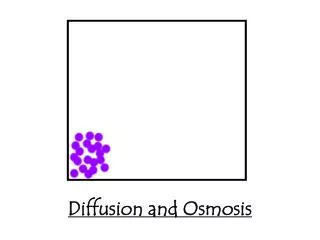
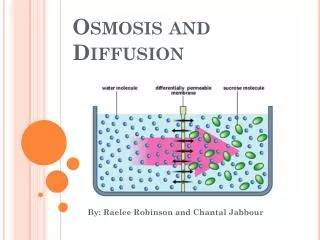
What is osmosis and diffusion? • Diffusion is the movement of molecules from an area of higher concentration to an area of lower concentration. • Osmosis is the movement of water across a membrane in response to a solute concentration gradient.
Why is osmosis and diffusion important? • Adults have approx. 60% water • 42 L • Intracellular fluid =28L • Interstitial fluid = 11 L • Plasma = 3L • Water is the solvent for all living matter
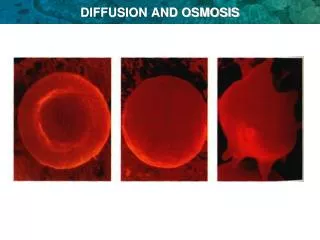
Tonicity • Tonicity pertains to a solution and how it affects cell volume • Hypertonic = solution makes cell shrink • Hypotonic = solution makes cell swell • Isotonic = cell does not change (optimal solution)
Surface Area to Volume ratio • Efficiency of a cell is based on its size
rate of diffusion • Nonpolar molecules diffuse rapidly • Ions use protein channels • Polar molecules use facilitated diffusion
Passive transport • No energy is used for osmosis to occur • Osmosis occurs by facilitated diffusion • Protein channel is needed for diffusion to take place • Aquaporins are used to diffuse water in and out of the cell