Mastering Soup: Categories, Production Principles, and Preparation Techniques
This comprehensive guide equips students with essential skills in soup preparation. Learners will explore various types of soups—including clear, thick, cream, and specialty soups—while understanding key principles of production and thickening agents. The course emphasizes the importance of quality ingredients, from the finest selections to utilizing leftovers, ensuring adherence to sanitation practices. Key techniques such as sautéing, simmering, and garnishing will be covered, enhancing both flavor and presentation. Students will gain confidence in creating a diverse range of soups, appreciating their role in culinary arts.

Mastering Soup: Categories, Production Principles, and Preparation Techniques
E N D
Presentation Transcript
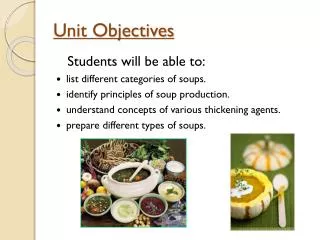
Unit Objectives Students will be able to: • list different categories of soups. • identify principles of soup production. • understand concepts of various thickening agents. • prepare different types of soups.
Soup • A liquid, savory food commonly made with meat, poultry, fish, or vegetable stock as its base. • Soups can be served either hot or cold • Specialty soups have their ownset of principles.
Soups • Wide variety of ingredients, seasonings, and garnishes • World’s finest ingredients or leftovers can be used to make quality soup • If you use leftovers, follow strict sanitation principles • The quality of a soup is determined by its ingredients, flavor, appearance, and texture
Types of Soups • Clear soups and Broths • Thick Soups • Cream soups • Purée soups • Other Soups (Specialty) • Bisque and Chowders • Cold soups
Broth Based Soups • Broth- A flavorful liquid obtained from the long simmering of meats and/or vegetables. • Vegetables: • Complement one another • Visually attractive • Add when appropriate • Cook grain/pasta separately.
Broth Based Soup Production • Sauté, sweat or simmer the ingredients. • Add broth or stock. • Add seasonings. • Continue to simmer until the desired flavor is achieved – skim as needed • Adjust seasonings.
Thick Soup- Cream • Any soup with the addition of cream/milk • Variations: • Veloute finished with heavy cream. • Béchamel based soups.
Thick Soup- Puree • Puree • Finely chopped/mashed ingredients • Used as a thickener • Usually done toward the end of cooking • Distinct impact on texture • Sometimes ½ of garnish not pureed for desired texture • Soup can be finished with cream (vegetable)
Chowder- Typically contain potatoes, milk, pork or bacon fat, onions, celery and often shellfish, fish or vegetables. Specialty Soups • Special ingredients or techniques that reflect regional cuisine. • Bisque– traditionally, thick soups made from shellfish and thickened with cooked rice.
Borscht Seafood Gumbo Specialty Soups
Garnishing Soups • The word garnish has two meanings when applied to soups: • Food added to soups as a decoration • Foods that serve as decorations but also as critical components of the final product