

SlideServe
Menu
Préférences
© SlideServe · v2026

Unit Objectives

kathywelch avatar
27 diapositives · 308 Views · Jan 07, 2020

Learn essential techniques to identify and treat the "killers" in disaster scenarios, including airway obstruction, bleeding control, and shock treatment. Understand the importance of triage and the phases of DEATH in medical operations post-disasters, based on research findings and effective triage methods. Gain insight into performing triage efficiently and avoiding common pitfalls in emergency response situations.
Unit Objectives - slide 1
01 / 27Unit Objectives
1 / 17

Télécharger la présentation

Unit Objectives
Une image / un lien ci-dessous est fourni (tel quel) pour télécharger la présentation

Politique de téléchargement : le contenu du site vous est fourni TEL QUEL pour votre information et votre usage personnel ; il ne peut être vendu, concédé sous licence ni partagé sur d’autres sites sans l’accord de son auteur.Le contenu vous est fourni TEL QUEL, pour votre information et votre usage personnel uniquement. Téléchargez la présentation en cliquant sur ce lien. Lors du téléchargement, si vous ne parvenez pas à télécharger une présentation, l’éditeur a peut-être supprimé le fichier de son serveur.Pendant le téléchargement, si vous ne parvenez pas à obtenir une présentation, le fichier a peut-être été supprimé par l’éditeur.

F I N

Plus de contenu associé

Transcription de la présentation
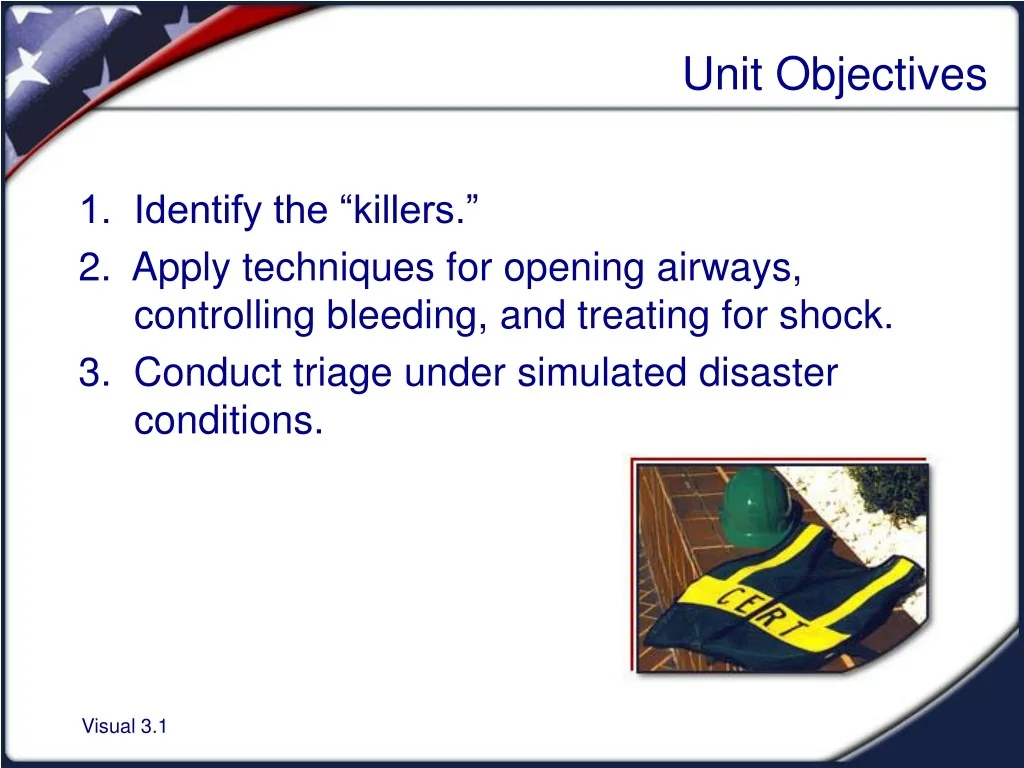
  1. Unit Objectives 1. Identify the “killers.” 2. Apply techniques for opening airways, controlling bleeding, and treating for shock. 3. Conduct triage under simulated disaster conditions.

  2. Medical Operations Medical Operations function under two assumptions • Number of victims will exceed the local capacity for treatment • Survivors will assist in treatment

  3. Medical Operations Three phases of DEATH Phase 1 – Death within minutes Phase 2 - Death within several hours – as a result of excessive bleeding Phase 3 – Death within several days – due to infection or multiple organ failure

  4. Medical Operations • Peter Saffir’s research on post disasters indicated: • 40 % of disaster victims in 2nd & 3rd phases of death could be saved if proper care was provided

  5. Hurricane Michael

  6. Hurricane Michael

  7. Medical Operations CERT personnel are trained: • Treatment of Life Threatening Conditions • The Three Killers • Greatest good for the greatest number of victims

  8. Treatment of Life-Threatening Conditions The 3 “Killers”: • Airway obstruction • Excessive bleeding • Shock

  9. Killer #1 Airway Obstruction Question: What is the most common airway obstruction in a disaster situation?

  10. The Tongue

  11. Open Airway • Open Airway using Head Tilt Method • Maintain open Airway

  12. Killer # 2 Controlling Bleeding • An adult has about 5 liters of blood - Losing 1 liter can cause death • Three Types of Bleeding • Arterial – Spurting • Venous – Flowing • Capillary - Oozing

  13. Methods of Controlling Bleeding

  14. # 3 Killer - Shock Shock is a disorder resulting from ineffective circulation of blood Shock Leads to Death of : • Cells • Tissues • Entire Organs

  15. Shock Shock happens in stages – body can mask the symptoms. • Must continually monitor all victims • Know the signs of shock

  16. Signs of Shock • Rapid Shallow Breathing – respirations > 30 • Capillary refill > 2 seconds – Blanch Test • Failure to follow simple commands • “ Squeeze My Hand”

  17. Treatment of Shock • Control bleeding if appropriate • Lie on Back with feet elevated 6- 10 inches • Maintain open airway • Maintain Body Temp • Avoid excessive movement

  18. CERT Medical Operations Triage M*A*S*H

  19. MASH • Mobile • Army • Surgical • Hospital

  20. Triage Triage means to sort • Victims are evaluated • Sorted by urgency • Immediate Treatment • Delayed Treatment

  21. Triage Triage is very effective when: • More victims than rescuers • Limited Resources • Time is critical

  22. Triage in a Disaster Environment Step 1 - Stop, Look, Listen, & Think Step 2 – Voice Triage – call out “Emergency Response Team, If you can, come to the sound of my voice” Step 3 – Start where you stand and work out

  23. Triage Step 4 – Evaluate and Tag • Immediate (I) • Delayed (D) • Dead (DEAD)

  24. Triage Step 5 – Treat “I” Immediate Victims First • Airway • Bleeding • Shock

  25. Triage Step 6 – Document • Effective deployment of resources • Info on victims and location • Quick record of casualties & severity

  26. Performing Triage Use 30 – 2 Rule (15-30 seconds) • Check for Breathing> 30/min. Tag “I” • Blanch Test - > 2 seconds Tag “I” • Mental Status – no response Tag “I” (“Squeeze my hand”) If Victim passes all 3 than Tag “D” Everyone gets a Tag!!!!

  27. Triage Pitfalls • No team plan, organization, or goal • Indecisive leadership • Too much focus on one injury • Treatment (rather than triage) performed