From Static to Dynamic: Understanding Evolutionary Logic in Biology Education
This comprehensive guide illustrates the transition from static to dynamic evolutionary models in biology, emphasizing the importance of evolutionary logic across different biological domains. Designed for educators and students in grades 5-11, the material covers botany, zoology, anatomy, physiology, and more, with a focus on molecular biology and ecology. The text encourages experimentation through molecular dynamics, enabling students to grasp complex concepts like diffusion, osmosis, and the biochemical basis of life. This resource aims to enhance reasoning and understanding of biological processes.

From Static to Dynamic: Understanding Evolutionary Logic in Biology Education
E N D
Presentation Transcript
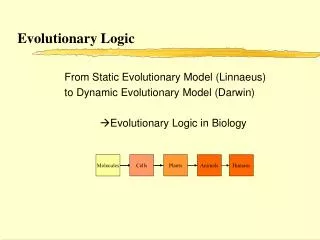
Molecules Cells Plants Animals Humans Evolutionary Logic From Static Evolutionary Model (Linnaeus) to Dynamic Evolutionary Model (Darwin) Evolutionary Logic in Biology
Vertical Instructions & Retrospection • 5-6 grades: Botany • 6-7 grades: Zoology • 7-8 grades: Anatomy/Physiology • 9 grades: Evolutionary Theory & Ontogenesis • 10 grade: Cell • 11 grade: Molecular Biology & Ecology
Molecules Molecules Cells Cells Plants Plants Animals Animals Humans Humans Horizontal Instructional Models Get it and Forget it A Reference reinforces, but will it enhance reasoning? Compare AP & Low: the less AP the more linear
Lab Investigation Concept Instructional Domains Instructional topics from different parts of the course
Protein folding Protein stability Enzyme catalysis Specific protein-protein recognition. Molecular Visualization Electrostatic potential of proteins caused by charged side chains and bound ions AND
Molecular Dynamic FromMemorizing Static Chemical Formulas & Balancing Chemical Equation/Stoichiometry ToExperimenting with Molecular Dynamic Models Molecular Visualization Coupled with Molecular Dynamic Models May Make Molecular World Relevant to Students Allow Introduction of Molecular Logic in Biology
Diffusion & Osmosis Solutions and Solubility Chemical Kinetics Molecular Kinetic Motion Basic Models: Pillars for Instructional Domain
Biotechnology: Molecular separation Cell Membrane Cell Membrane * Diffusion & Osmosis Dynamic Model Cell nourishment Physiology: Digestion Cells: Waste Elimination Physiology: Excretory system Cells: Chemical transport Physiology: Respiratory System Plant cells; Turgor Botany Physiology: Kidney function Leaves & Transpiration Botany Physiology: Nervous system Root function Botany Physiology: Circulatory systems Diffusion and Multiple Biology Topics
Neuron Model Cascades: Relaying Signals Digestion Model Active Transport: ATP Kidney Model Facilitated Diffusion & Reverse Unicellular Model Membrane: Gradients & Barriers Membrane Model Simple Diffusion: Dynamic Equilibrium Progression of Models
From Simple Diffusion Model to ATP Diffusion Osmosis Active Transport Maintaining Gradients & Conserving Energy Chemo-osmotic potential ATP formation Bioenergetics
Biopolymers Amino acids interactions Protein Folding Proteins: Form & function Protein: Self-Assembly Molecular Morphogenesis Molecular Adaptation Genetics Evolution Molecular Dynamic & Dynamic Evolution Atoms & electrons Functional Groups Chemical Reactions Molecular Diversity Electro-negativity
Statistical Nature of Molecular Behavior + Forces of Molecular Interactions Statistical Nature of Genetic Variation + Selection Pressure Molecular Dynamic & Dynamic Evolution Models