Introduction to Matrices and Vectors: Concepts and Properties
460 likes | 608 Vues
This overview introduces matrices and vectors as fundamental elements in engineering disciplines such as instrumentation, circuit design, communications, and microelectronics. A matrix is defined as a rectangular array featuring m rows and n columns, with specific types classified by their properties, such as square, symmetric, and triangular matrices. The document covers matrix operations, including addition, scalar multiplication, and multiplication rules. It also discusses vector products, including dot and outer products, and highlights essential concepts such as transpose and complex conjugate. Exercises are provided to enhance understanding.


Introduction to Matrices and Vectors: Concepts and Properties
E N D
Presentation Transcript
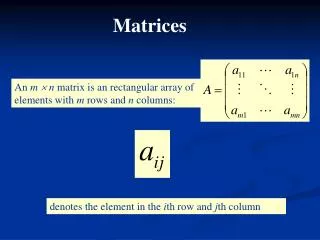
An m n matrix is an rectangular array of elements with m rows and n columns: Matrices denotes the element in the ith row and jth column
Matrices y vectores son fundamentales en el estudio formal de todas las ramas de la ingeniería • Instrumentación • Diseño de circuitos • Comunicaciones • Microelectrónica
Vectors A column vector is a matrix with n rows and 1 column A row vector is a matrix with 1 row and n columns
Classification of matrices Square: m=n
Symmetric: aji = aij
Upper Triangular: aij = 0 when j < i
Lower Triangular: aij = 0 when j >i
Diagonal: aij = 0 when j i
Identity: aii = 1 aij = 0 when j i
Scalar multiplication B = kA • Dimensions: • Example
Matrix multiplication C = AB Only possible if the number of columns of A is equal to the number of rows of B
Matrix multiplicationis a non-commutative operation (generally):
Identity: aii = 1 aij = 0 when j i
Vector products: (u,v are column vectors) • Dot product or inner product • Outer product:
Scalar product (of vectors) The product of a row vector a and a column vector b is a scalar a b = a1b1 + ... + anbn
Trace The trace of a nxn matrix A is given by:
Properties of Matrix Operations • A+B = B+A • A+(B+C) = (A+B)+C • A(BC) = (AB)C • A(B+C) = AB+AC • (B+C)A = BA+CA • a(B+C) = aB+aC Commutative law for addition Associative law for addition Associative for multiplication Left distributive law Right distributive law Distributive law for scalar multiplication
(a+b)C = aC+bC a(bC) = (ab)C a(BC) = (aB)C
Transpose B = AT • Dimensions: • Formula: • Example
Alternative notation used in some books B = AT B = A’ In this course we use the first one (B = AT )
Symmetric matrix: AT = A • Skew-symmetric matrix: AT = -A
Symmetric Skew-symmetric Unitarymatrix
Alternative notation used in some books for Matrix Complex Conjugate In this notes we use the bar
ComplexHermitian Example:
examples: Hermitian: Skew-Hermitian Unitary
Exercises : (a) Find A such as: (b) Find A such as: