Download
1 / 30
310 likes | 445 Vues
Mercury, the closest planet to the Sun, presents unique challenges for observation due to its proximity and rotation characteristics. With an unusual 3-to-2 spin-orbit coupling, a single day on Mercury lasts 88 Earth days. This makes it visible for limited periods shortly after sunset or before sunrise. The Mariner 10 mission revealed a heavily cratered surface, distinct from the Moon, with scarps and gently rolling plains. Current missions aim to uncover more about Mercury's internal structure and magnetic field, raising questions about its geology and atmospheric interactions.

E N D
Guiding Questions • What makes Mercury such a difficult planet to see? • What is unique about Mercury’s rotation? • How do the surface features on Mercury differ from those on the Moon? • Is Mercury’s internal structure more like that of the Earth or the Moon?
Earth-based optical observations of Mercuryare difficult • At its greatest eastern and western elongation, Mercury is never more than 28° from the sun • It can be seen for only brief periods just after sunset or before sunrise
Solar Transit Transits occur about twelve times a century when the sun, Earth and Mercury are aligned There will be a transit on November 8, 2006
Best Earth-based Views of Mercury Difficulties observing Mercury from Earth led early astronomers to incorrectly decide that Mercury always kept the same face towards the sun in synchronous orbit Note phases like the moon
Mercury rotates slowly and has an unusualspin-orbiting coupling
Radio telescope observations from sites such as Arecibo gave evidence of a non-synchronous orbit
Mercury spins 1 ½ times on its axis for every complete orbit • Mercury spins three times during every two orbits
Strong tidal effects, Mercury’s slightly elongated shape and its very eccentric orbit cause this strange 3-to-2 orbit • A “day” of solar light on Mercury would be 88 earth days
Images from Mariner 10 reveal Mercury’s heavilycratered surface • Most of our detailed information about Mercury’s surface is from this fly-by mission in 1974/1975. • Mariner only saw one side of the planet. • There are presently three planned missions to Mercury with data return beginning in 2009.
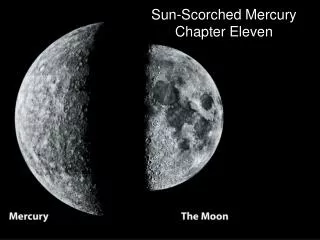
Heavily cratered surface • Less dense cratering than moon • Gently rolling plains • Scarps • No evidence of tectonics
Note how much more densely the craters occur on the moon’s surface.
Scarps are cliffs This one is more than a km high They probably formed as the planet cooled and shrank
The seismic waves from the impact that caused the Caloris Basin caused this deformation on the opposite side of Mercury
Mercury has an iron core and a surprisingmagnetic field • Most iron-rich planet in the solar system with a core that is 75% of the diameter • The earth’s core is 55% of its diameter and the moon’s core is 20% of its diameter • Highest density for the planets • Weak magnetic field indicating part of the core is liquid • Magnetic field causes a magnetosphere similar to Earth’s but weaker
The magnetosphere blocks the solar wind from reaching the surface of the planet
Key Terms • greatest eastern elongation • greatest western elongation • solar transit • 1-to-1 spin-orbit coupling • 3-to-2 spin-orbit coupling • scarp