Understanding Valence Electrons and Their Role in Chemical Reactivity
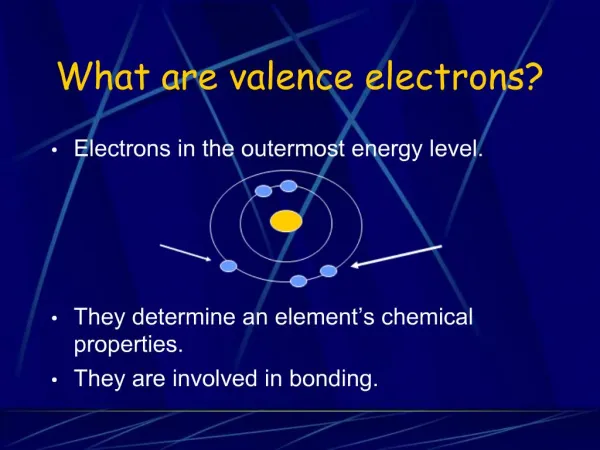
Valence electrons are the outermost electrons in an atom, crucial for determining its chemical properties. They occupy orbitals within specific energy levels, typically residing in the outermost shell. For instance, hydrogen has one valence electron, while neon has eight, corresponding to its complete outer shell. The reactivity of an atom largely hinges on its valence electrons; atoms with full valence shells are stable and less reactive, whereas those with fewer electrons are more likely to engage in chemical reactions. Understanding these concepts is fundamental to studying the periodic table and atomic behavior.

Understanding Valence Electrons and Their Role in Chemical Reactivity
E N D
Presentation Transcript
Electrons • Electrons are found in orbitals within energy levels • The regions in an atom where electrons are found are called orbitals • Electrons usually occupy the lowest energy levels available in an atom
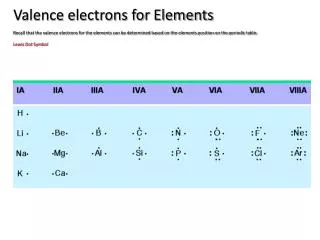
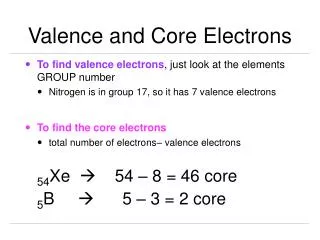
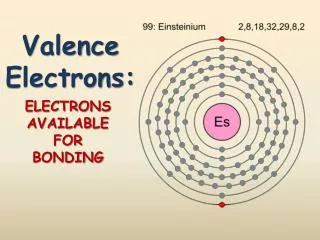
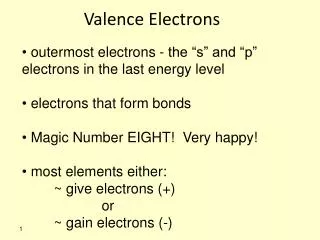
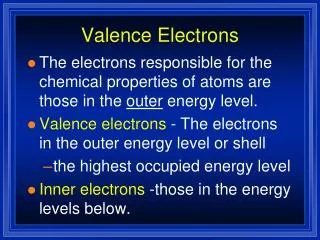
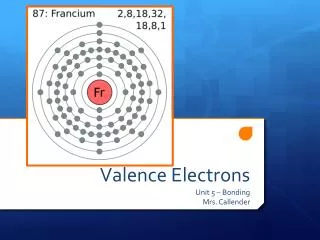
Valence electrons • An electron in the outermost energy level of an atom is called a valence electron • Ex. • The single electron of a hydrogen atom is a valence electron because it is the only electron the atom has • In a neon atom, its valence electrons are the eight electrons that are in the outermost energy level
Chemical Reactivity • The chemical reactivity of an atom is mainly determined by valence electrons • Atoms with a complete (full) valence shell are not reactive • Atoms with one or two valence electrons are highly reactive • Orbitals that are empty, half-full, or full are more stable