Download
1 / 8
80 likes | 206 Vues
Japan is an archipelago made up of more than 3,000 islands, with its seas providing natural protection against invasions. It has a rich cultural and spiritual heritage, with Shinto as its major religion, where kami are revered spirits associated with nature. Historically, political structures evolved from clan governance to a feudal system dominated by shoguns who held significant power until the 1700s. The modern Japanese emperor, currently Emperor Akihito, is a direct descendant of the first Yamato emperor, reflecting the enduring legacy of Japan's historical hierarchy.

E N D
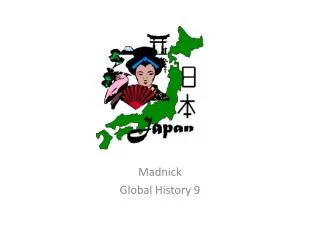
Madnick Global History 9
Chain of islands Japan-the basics • Made up of more than 3,000 islands. • Seas protected Japan from invasion • Never conquered by other people archipelago
Shinto • Japan’s major religion • Kami=Shinto gods/spirits • Kami are found in nature: Earth, Fire, Wind, Water • special humans become kami after they die, especially the emperor
Political/Social Systems His Imperial Majesty AKIHITO, the 125th Emperor of Japan, of the Supreme Order of the Chrysanthemum, Order of the Rising Sun, Order of the Sacred Treasure, elder son of the late Emperor Hirohito and Empress Kojun , born on 23 December 1933 at the Imperial Palace in Tokyo. • People of early Japan lived in clans • 300-Yamato clan became dominant • Yamato leader became first emperor • modern emperor is a direct descendant of first Yamato emperor
Social/Political Systems • 800-1200 -Japanese government grew weaker • 1185- Yoritomo Minamoto named first shogun (general) • Shogun had all political and military power in Japan until 1700’s
Social/Political Systems • Under shoguns, Japan developed a social/political system called feudalism -social/political system based on ownership of land, military service to one’s superior, and loyalty between rulers and the ruled
Japanese Feudalism Emperor Shogun Daimyo Samurai Peasants
Japanese Feudalism • Emperor-respected by all; no real power • Shogun-real political and military power -controlled all land • Daimyo-ran estates based on to shogun’s rules • Samurai- professional warriors; served daimyo • Peasants-tied to land; produced all food