Download
1 / 13
130 likes | 253 Vues
This presentation by Chetan Bhole covers advanced techniques in cortical flattening for the visualization of brain structures in MRI scans. It discusses the importance of cortex segmentation, normalization, and skull stripping. Key methods include minimizing folding and metric distortion while finding geodesic distances between points. The talk addresses previous visualization methods in both 2D and 3D contexts, and it highlights the use of spherical coordinates and Delaunay triangulation for accurate surface mapping. References include seminal works on cortical surface analysis.

E N D
Cortical flattening for Visualization Presentation by Chetan Bhole [4]
Structural 2D slice of brain (MRI) White matter gray matter Or cortex skull • Note On: • Functional imaging • Importance of cortex
Segmentation of the cortex • Normalization • Skull Strip • Segmentation
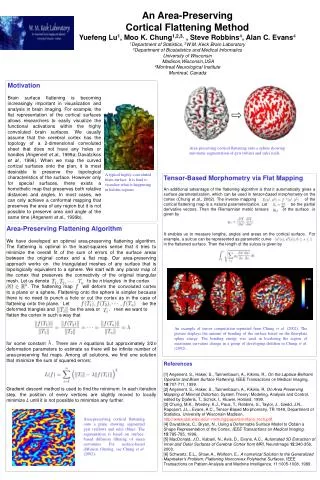
Cortical flattening • Flatten and unfold the cortex • Use of boundary between white and gray matter • Requirements • Minimal folding • Minimal metric distortion
Cortical flattening: I Find the geodesic distances between points in a cut Minimize Energy fn: J = λdJd + λaJa
Results Map to flat surface Map to spherical surface Inflation: wrt mean curvature Inflation: wrt convexity
Spherical coordinate system • Comparing information across patients
Cortical flattening: II choose points draw mesh adjust distances result map on flat surface Perform Delanauy triangulation
References • Cortical Surface Based Analysis, I: Segmentation and Surface Reconstruction, Anders Dale, Bruce Fischl, Martin Sereno 1998 • Cortical Surface Based Analysis, II: Inflation, Flattening and a Surface-Based Coordinate System, Bruce Fischl, Martin Sereno, Anders Dale, 1998 • Visualization and Measurement of the Cortical Surface, Brian Wandell, Suelika Chial, Benjamin Backus, 2000 • http://vision.psy.mq.edu.au/~peterw/corella/315/fMRI.part2.pdf