Download
1 / 7
70 likes | 195 Vues
This analysis by Mindaugas Danys explores the evolving landscape of Regional Development Agencies (RDAs) in Central and Eastern European Countries (CEEC) as they navigate the complexities between public and private sectors. It discusses the challenges of ownership models, the viability of non-profit consultants, and the balance between regional promotion and global service selling. The paper also contrasts spending versus earning among RDAs, the differences with Western Europe counterparts, and envisions a future model that emphasizes consulting capabilities and diversified operations.

E N D
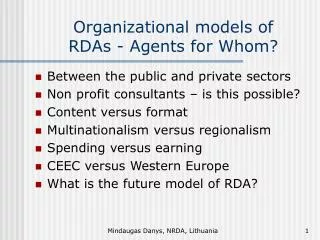
Organizational models ofRDAs - Agents for Whom? • Between the public and private sectors • Non profit consultants – is this possible? • Content versus format • Multinationalism versus regionalism • Spending versus earning • CEEC versus Western Europe • What is the future model of RDA? Mindaugas Danys, NRDA, Lithuania
Between the public and private sectors Ownership of RDAs varies: • Public (local, regional, governmental, NGOs) • Quasi (public – private); Private business • Private (individuals) Ownership and company type is not essential in measuring RDAs efficiency Mindaugas Danys, NRDA, Lithuania
Non profit consultants – is this possible? Many RDAs choose to save on taxes by being registered as non profits. If RDA is not supported by public funds it looses it’s identity by moving where the money are (based on funding priorities). Mindaugas Danys, NRDA, Lithuania
Multinationalism versus regionalism Western RDAs are active sellers of their services in the rest of the World What is the balance between their mission to promote their region and selling services abroad? What effect of accession will be on consulting fees with huge supply of cheaper consultants from CEEC Mindaugas Danys, NRDA, Lithuania
Spending versus earning There is division between those RDAs that spend public funds on business development etc and those who earn money through tenders. Which are better? Which create more of public good? Shouldn’t RDAs separate its’ activities? Mindaugas Danys, NRDA, Lithuania
CEEC versus Western Europe CEEC RDAs move towards the status of RDAs in WE but the process is slow and mixed in different areas. What will happen after EU accession? Mindaugas Danys, NRDA, Lithuania
What is the future model of RDAs in CEEC? • Strong in consulting • Local roots but more services provided outside the region • Decreased links with shareholders • Increased private ownership by staff • Still strong in both administration of public funds and implementation of projects • Big business with Phare ESC Programme • No longer priority treatment for EU consultants • We have to become movers ann shakers not only in one’s region but in the country too. Mindaugas Danys, NRDA, Lithuania