Download
1 / 13
130 likes | 258 Vues
Explore the significance of major trade routes that shaped world history. The Silk Road facilitated trade between East Asia and the Middle East, exchanging silk, porcelain, and spices, while also spreading innovations like paper and gunpowder and religions such as Buddhism. Similarly, the Indian Ocean Maritime Trade connected East Africa, the Middle East, and South Asia, promoting the spread of Islam and Indian textiles. The Trans-Sahara trade linked Mediterranean lands with Sub-Saharan Africa, trading gold and salt, while Northern European routes fostered the spread of Christianity. Understand how these connections influenced cultures and economies.

E N D
Trade Networks World History SOL WHI 10 a
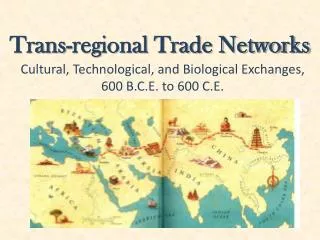
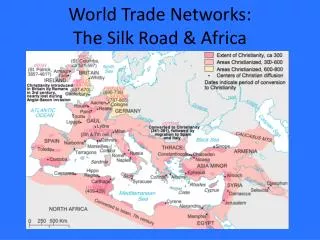
Silk Road • Major trade route from East Asia to the Middle East • Items traded – Silk, Porcelain, Spices • Innovations – Paper, compass, gunpowder • Religion – Buddhism from India into China
Indian Ocean Maritime Trade • Major trade route connecting East Africa, Middle East, and South Asia • Items traded – Textiles, spices, gold, ivory • Innovations – Lateen sail to Middle East and Europe from India • Spread of Religion – Islam spread to East Africa and Southeast Asia, Hinduism and Buddhism spread from India to Southeast Asia
Trans-Sahara Trade Route • Major trade route across the Sahara Desert in North Africa, connected Mediterranean lands with Sub-Saharan Africa • Items traded – Gold, salt, ivory • Spread of Religion – Islam spread into North Africa
Northern European Trade • Major trade route from the Baltic Sea region south to Black Sea and West to Western Europe • Items traded – furs, amber, fish, and timber from Northern Europe to Southern Europe • Spread of religion – Christianity spread into Northern Europe (Catholic and Orthodox)
South China Sea Trade • Major trade route from Southeast Asia to China and Korea • Items traded – Porcelain, silk, textiles, from China and spices from Southeast Asia • Spread of Religion – Buddhism to China, Korea, Japan