Efficient Wide Field Imaging with Astro-Wise: Managing Calibration and Data Quality
170 likes | 287 Vues
Astro-Wise revolutionizes wide field imaging by streamlining handling, calibration, and quality control, enabling researchers to process and disseminate vast amounts of image and catalogue data. With robust production across EU federations and integrated workflows, the system ensures 100% data lineage and user-tuned research. Featuring dynamic databases and advanced pipelines, Astro-Wise facilitates seamless data processing and archiving, allowing for on-the-fly re-processing and direct publication. With a suite of tools built in Python, it supports collaborative astronomical research across global grids.


Efficient Wide Field Imaging with Astro-Wise: Managing Calibration and Data Quality
E N D
Presentation Transcript
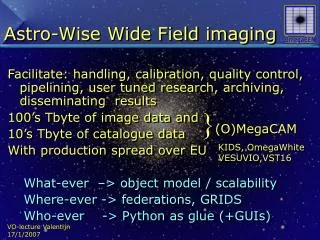
Astro-Wise Wide Field imaging Facilitate: handling, calibration, quality control, pipelining, user tuned research, archiving, disseminating results 100’s Tbyte of image data and 10’s Tbyte of catalogue data With production spread over EU What-ever –> object model / scalability Where-ever -> federations, GRIDS Who-ever -> Python as glue (+GUIs) }(O)MegaCAM KIDS, OmegaWhite VESUVIO,VST16
Virtual Survey Telescope • raw pixel data pipelines/cal files catalogues • all integrated in one information system • 100% data lineage • distributed services • processing GRID • Storage GRID • Methods/services GRID NL:Leiden, Nijmegen, Groningen, Amsterdam EU: Napoli, Munchen, Bonn, Heidelberg, Paris World: Santiago
Astro-Wise VO Properties Benefits integrated dynamic db • on-the fly re-processing • 5LS: 5 Lines Script • All bits are traced • Administration for parallel processing compute GRID SETI@home • Global solutions –astrometry/photometry • Build–in workflow • Fully user tunable – own provided script • Context: projects/surveys, instruments, mydb • Publish directly in EURO-VO
time • Calibrations vary in time due to • Physical changes • eg gain of detectors, atmosphere, flexure in telescope • Our insight in these changes, better modeling • Bugs in code and improved coding
Bias pipeline Source pipeline Flatfield pipeline Photometric pipeline Image pipeline Astro-Wise Pipelines
Target processing:++ the make metaphor awe> targethot=HotPixelMap.get(date='2003-02-14', chip='A5382') The processing chain is ReadNoise <-- Bias <-- HotPixels • > class HotPixelMap(ProcessTarget): • > > def self.make() • > class ProcessTarget(): • > > def get(date, chip) # if not exist/up-to-date then make() • > > def exist() # does the target exist? • > > def uptodate() # is each dependency up to date? Fully recursive
Example 5LS #Find ScienceFrames for a ccd named ccd53 and filter Awe> q = (ReducedScienceFrame.chip.name == 'ccd‘) and (ReducedScienceFrame.filter == ‘841’) # From the query result, get the rms of the sky in image Awe> x = [k.imstat.stdev for k in q] # get the rms of the used Masterflat Awe> y = [k.flat.imstat.stdev for k in q] # Make a plot Awe> pylab.scatter(x,y)
Awe - GRIDS • Collected in database – Oracle 10g snd federated servers using STREAms • distributed services Virtual Survey Telescope • Code base, documentation, how-to’s (CVS) • processing GRID • Storage GRID • Access to everything archive - SQL • Methods/services GRID • facilitate research environment • Linux Python prompt • Bundled in web services www.astro-wise/portal