Understanding Kahneman's Fourfold Pattern: The Psychology of Risk and Decision Making
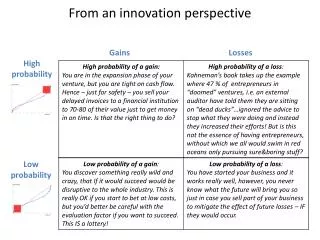
Explore Kahneman’s Fourfold Pattern, which illustrates how people perceive gains and losses differently based on probabilities. This psychological model reveals that high-probability gains are often undervalued, while low-probability but high-impact events tend to be exaggerated in decision making. For instance, although the chance of winning a lottery is less than 1%, individuals readily buy tickets, driven by hope. Conversely, likely events, like winning a court case, may lead to settling for less. Understand the interplay between rationality and emotion in financial decisions.

Understanding Kahneman's Fourfold Pattern: The Psychology of Risk and Decision Making
E N D
Presentation Transcript
From an innovation perspective “Kahneman’s “Fourfold pattern” Over- and underweighting Gains Gains Losses Losses High probability High probability the Rational Utility line Low probability. Unlikely events are considerably overweighted by your right brain. Examples: Chance to win €1 million in a lottery is << 1%, still you take a decision to buy a ticket Risk that Your house may burn down is <<1%, still you take a decision to buy a fire insurance Gain of certainty,loss of some money! Gain of hope, loss of much money! High probability Likely events are even more underweighted by your right brain Examples: Chance to win in a court case on €1 million is >>95%, still you agree to settle at €0.8 million Risk that You are about to get bankrupt on the casino is very high. Still You take a large loan from the mafia and bet all on number Zero….. Low probability Gain of certainty, loss of some money! Gain of hope, loss of some money! Low probability the Irrational Utility curve