Science study guide
This study guide provides an overview of fundamental concepts related to the kinetic energy of matter, its states, and temperature measurement. It explains how temperature reflects the average kinetic energy of particles and the role of thermometers in measuring this. Key energy transfer processes such as conduction, convection, and radiation are discussed, along with the distinctions between conductors and insulators. Additionally, it covers concepts like specific heat, changes of state, wave properties, and the nature of chemical reactions, enabling a deeper understanding of physical science.

Science study guide
E N D
Presentation Transcript
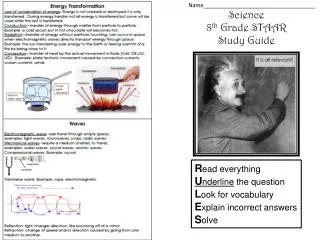
SC.A.1.3.1 • The kinetic of matter- states that all of the particles that make up matter are constantly in motion. • Temperature is a measure of the average kinetic energy of all the particles in an object. • Degrees which are equally spaced units between 2 points. • Thermometer is measures temperature through the regular variations of the material inside the thermometer. • Heat is a flow of energy from an object at a higher temperature to an object at a lower temperature. • Thermal energy is the particles in an object. • Calorie is the amount of energy needed to raise the temperature of 1 gram of water by 1 C. • Conduction is the process that moves energy from 1 object to another when they are touching physically. • Conductors are materials that transfer energy easily. • Insulators are poor conductors. • Convection is the process that transfers energy by movement of large numbers of particles in the same direction within a liquid or gas. • Radiation is energy that travels as electromagnetic waves, such as visible light and infrared waves.
SC.A.1.3.3 • Specific heat is the amount of energy needed to change the temperature of 1kg of a substance. • State of matter the physical forms in which a substance can exists. • Change of state is a change of a substance from one state to another. • Wave is any disturbance that transmitted energy through matter or empty space. • Vibration a repetitive, back-and-forth motion of an object around its rest position. • Medium a material through which waves can travel or it can be a solid, a liquid ,or a gas. Electromagnetic radiation are the radiation associated with an electric and magnetic field. Crest is the highest point of a wave. Trough is the lowest point of a wave.
SC.A 1.3.4 • Chemical reaction is the process in which one or more substances change to make one or more new substances. • Precipitate is the solid substance that is formed in a solution.